Anti-Spam Law Canada (CASL) 2026: What Businesses Must Know for Email Marketing

Imagine launching a carefully crafted email campaign to your Canadian customers, only to face hefty fines or lawsuits because you overlooked one key detail in compliance. That's the reality for busine...
The Lifetimes Canada editorial team curates, fact-checks, and updates guides on personal finance, property, health, immigration, legal, business, and lifestyle topics relevant to Lifetimes Canada readers. Articles are produced with AI assistance and reviewed by the editorial team before publication.
Imagine launching a carefully crafted email campaign to your Canadian customers, only to face hefty fines or lawsuits because you overlooked one key detail in compliance. That's the reality for businesses ignoring Canada's Anti-Spam Legislation (CASL) in 2026. As email marketing remains a powerhouse for reaching audiences, understanding CASL ensures your efforts build trust rather than penalties.
With fines reaching up to $10 million CAD per violation, CASL demands attention from every business sending commercial electronic messages (CEMs) to Canadians. Whether you're a small retailer in Toronto or a national e-commerce brand, this guide breaks down what you must know for 2026 compliance, straight from official sources and expert insights.
What is CASL and Why Does It Matter in 2026?
Canada's Anti-Spam Legislation (CASL), effective since July 1, 2014, protects consumers and businesses from spam, phishing, and other digital threats. It regulates CEMs—any electronic message encouraging commercial activity, including emails, SMS, and social media direct messages—sent to, from, or within Canada.
In 2026, CASL remains one of the world's strictest laws, with no major amendments diluting its core rules. It applies to all organizations doing business in Canada, even if you're based abroad but targeting Canadian recipients. Non-compliance risks not just fines from the CRTC, Competition Bureau, or Privacy Commissioner, but also private lawsuits from affected individuals.
For context, CASL complements other Canadian laws like PIPEDA for privacy, but focuses squarely on unsolicited messages harming electronic commerce.
Who Must Comply?
- Any business sending CEMs to Canadian electronic addresses.
- Organizations with existing lists from before 2014 must now rely on documented consent.
- Even one-off messages following referrals need specific handling.
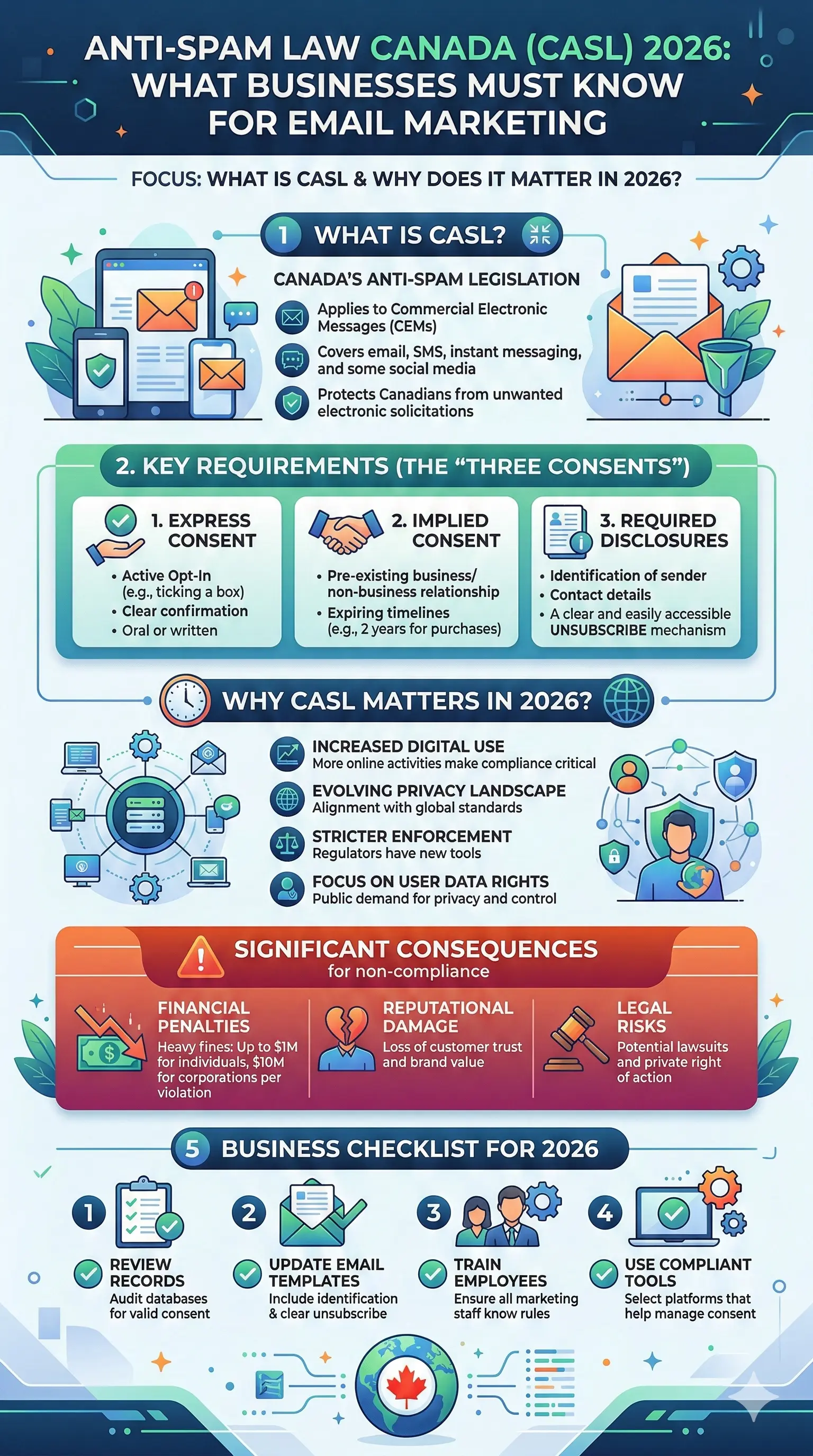
The Three Pillars of CASL Compliance
CASL boils down to three unbreakable requirements: obtain consent, provide identification, and offer an unsubscribe mechanism. Get these right, and you're on solid ground.
1. Obtain Consent: Express vs. Implied
Consent is king under CASL. You need it before sending most CEMs, with two types available.
Express Consent: The gold standard—clear, affirmative agreement from the recipient, orally or in writing (electronic counts). It doesn't expire but can be withdrawn anytime. When requesting it, disclose:
- Your identity and contact info.
- The message types you'll send.
- A sample message or title.
- An unsubscribe option.
Implied Consent: Allowed in limited cases, like existing business relationships (e.g., recent purchases) or memberships in clubs/associations. The three-year transition for implied consent ended in 2017, so most lists now require express consent. Referrals permit one initial CEM if you name the referrer and include sender details plus unsubscribe.
| Consent Type | Examples | Duration |
|---|---|---|
| Express | Double opt-in signup form | Indefinite (until withdrawn) |
| Implied | Recent customer inquiry; club membership | Limited by relationship (e.g., 2 years post-purchase) |
Document everything—proof of consent date, method, and content is crucial for audits.
2. Provide Identification Information
Every CEM must clearly state who you are and how to reach you, including a physical mailing address. No hiding behind vague "no-reply" senders. Headers and subject lines must be truthful—no misleading info.
Example: A Toronto bakery's newsletter should read "From: FreshBakes Toronto ([email protected] | 416-123-4567 | 123 Yonge St, Toronto, ON M5C 1W6)".
3. Include an Unsubscribe Mechanism
Offer a clear, free opt-out in every CEM, processed within 10 business days. Links must work for at least 60 days, and you can't charge recipients to unsubscribe. Honour requests promptly to avoid violations.
Common Pitfalls and How to Avoid Them in 2026
Even seasoned marketers trip up. Here's how to stay compliant.
Pitfall 1: Relying on Old Lists
Pre-2014 lists? Transition rules expired—refresh with express consent or purge. Use tools like Constant Contact, which enforce permission-based lists.
Pitfall 2: Forgetting Social and SMS
CASL covers texts and DMs too—not just email. A promotional Instagram DM to a Canadian counts as a CEM.
Pitfall 3: Ignoring Referrals and Members
Send one consent-seeking message post-referral, but name the referrer. For associations, stick to active members for implied consent.
Practical Tips for Canadian Businesses
- Audit lists quarterly: Remove bounces, inactives, and unsubscribes.
- Use double opt-in: Confirms real interest and documents consent.
- Integrate CRTC-compliant tools (e.g., Mailchimp's CASL features).
- Train teams: One rogue employee can trigger fines.
- Monitor updates via CRTC's CASL page.
Penalties for CASL Violations in 2026
Get it wrong, and pay big. Organizations face up to $10 million CAD per violation; individuals up to $1 million. The CRTC has issued over $20 million in fines since 2014, with private actions adding damages.
Recent example: A major telco fined for inadequate consent processes—lessons for all. Compare to U.S. CAN-SPAM ($50,000 USD/email) or GDPR (€20M), CASL's bite is sharp for Canada-focused ops.
"CASL is among the world’s strictest email marketing laws." Vertical Response Guide
FAQ: CASL Questions Canadian Businesses Ask
Does CASL apply to messages sent from outside Canada?
Yes, if targeting Canadian recipients or using Canadian networks.
Can I email purchased lists?
No—consent must be yours, not third-party. Always verify.
What about transactional emails like order confirmations?
Exempt if purely transactional (no promotions). Add upsells carefully.
How long do I keep consent records?
Indefinitely, or until purpose ends plus six years post-relationship.
Is there a grace period for new rules in 2026?
No major changes; core rules stand firm.
Who enforces CASL?
CRTC, Competition Bureau, Privacy Commissioner—plus private suits.
Next Steps to CASL-Proof Your Email Marketing
Start today: Review your ESP settings, audit lists, and draft a CASL policy. Consult legal experts or the Canadian Marketing Association for tailored advice. Tools like consent management platforms simplify compliance. Stay ahead—compliant marketing drives loyal customers without the risk.