Canada Cost of Living by City 2026: Where Is Actually Affordable?

Planning your next move in Canada? With housing prices climbing and everyday expenses adding up, finding a city where your paycheque stretches further feels like a smart strategy in 2026. We've crunch...
The Lifetimes Canada editorial team curates, fact-checks, and updates guides on personal finance, property, health, immigration, legal, business, and lifestyle topics relevant to Lifetimes Canada readers. Articles are produced with AI assistance and reviewed by the editorial team before publication.
Planning your next move in Canada? With housing prices climbing and everyday expenses adding up, finding a city where your paycheque stretches further feels like a smart strategy in 2026. We've crunched the latest data to reveal where the **Canada cost of living by city** truly offers value—without skimping on quality of life.
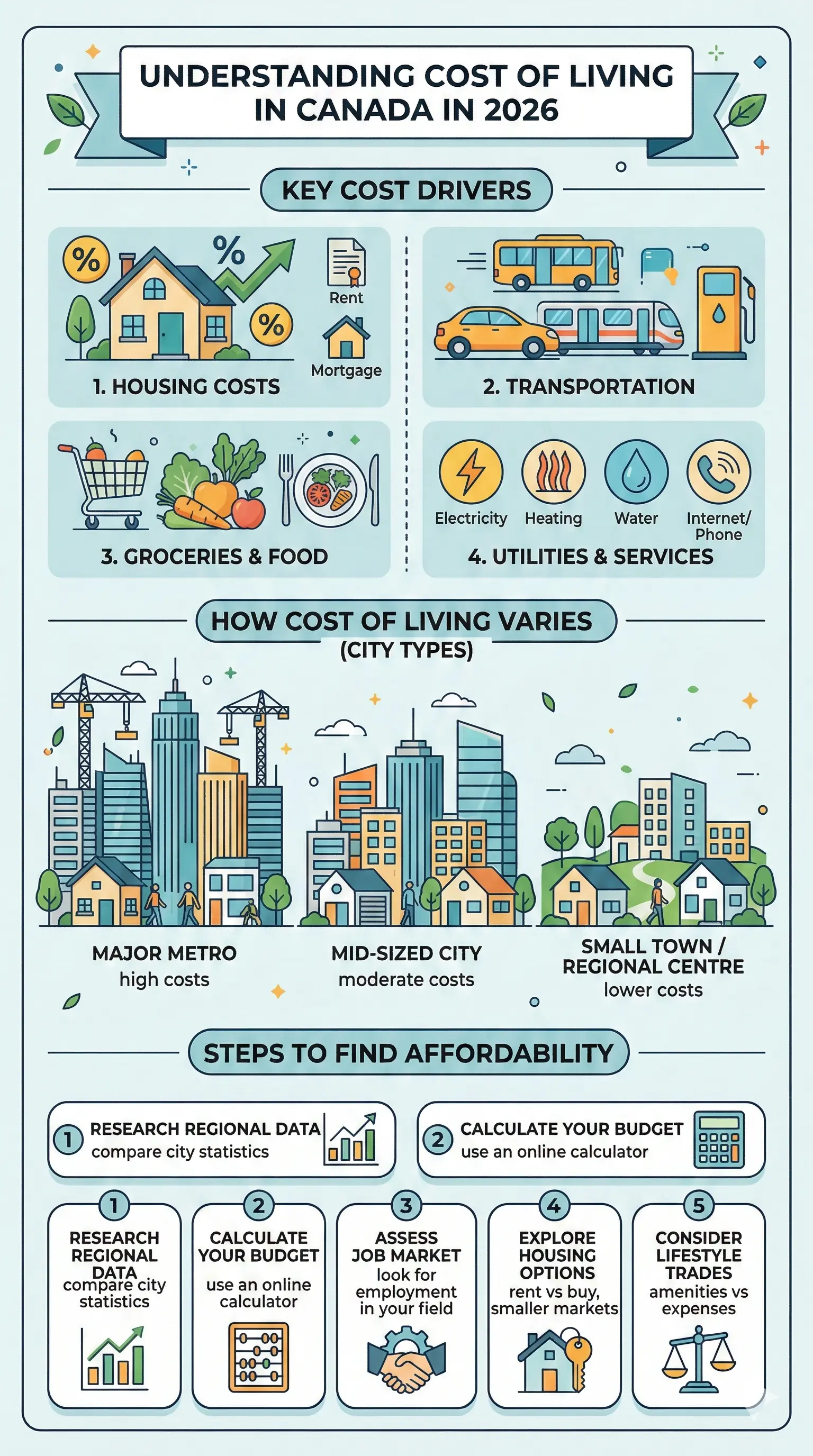
Understanding Cost of Living in Canada in 2026
Canada's cost of living varies wildly by city, driven by housing, groceries, transport, and utilities. For a single person, expect $3,300–$3,800 monthly on average, while a family of four faces $5,900–$6,400. Provinces like British Columbia and Ontario top the expensive list, but Saskatchewan, Manitoba, and Atlantic Canada keep things more manageable.
Numbeo's 2026 Cost of Living Index ranks Canadian cities against a global baseline (New York = 100). Lower scores mean better affordability. Vancouver and Toronto tie at 67.5, while Montreal scores a friendlier 59.9. Housing remains the biggest bite—often 30-50% of income—but cities like Winnipeg and Quebec City balance this with lower rents and solid salaries.
Key Factors Influencing City Costs
- Housing and Rent: Vancouver's one-bedroom city-centre rent hits around $2,500+, while Moncton dips under $1,500.
- Groceries and Dining: Expect $300-500 monthly for one; restaurant meals add $15-25 per person.
- Transport: Public transit passes range from $90 in Montreal to $150 in Toronto.
- Utilities: $150-250 for a small apartment, higher in colder climates.
Use tools like the CRA's budget planner or StatCan's cost-of-living calculator to personalise these for your situation.
Most Expensive Cities: Where Costs Bite Hardest
Vancouver leads as Canada's priciest city in 2026, with monthly costs for a family nearing $4,269—far outpacing average salaries. Toronto matches Vancouver's index at 67.5, with one-bedroom rents at $2,410 and property prices over $1,120 per sq ft. Halifax shocks as the only city where average costs exceed salaries, leaving families in deficit before extras.
Top Unaffordable Spots
| City | Cost of Living Index | Key Expense |
|---|---|---|
| Vancouver, BC | 67.5 | $4,269 monthly family costs |
| Toronto, ON | 67.5 | $2,410 1-bed rent |
| Calgary, AB | 64.5 | $590K median home |
| Halifax, NS | N/A | Costs > salary |
Even suburbs like Brampton and Mississauga feel the squeeze, with rents up 30% since 2020. If you're eyeing these, factor in CPP contributions and EI eligibility for stability.
Most Affordable Cities: Where You Can Actually Thrive
Lower indices signal relief. **Quebec City (60.6)** and **Montreal (59.9)** shine with moderate rents and vibrant cultures. Winnipeg (59.8) offers big-city perks at mid-pack prices, with family costs around $5,137 before rent and average salaries of $3,578. New Brunswick leads provinces at $2,300–$2,700 for singles.
Top Affordable Picks for 2026
| City | Cost of Living Index | Monthly Single Cost (excl. rent) | Why Affordable? |
|---|---|---|---|
| Quebec City, QC | 60.6 | $2,700–$3,300 | Low index, strong utilities value |
| Montreal, QC | 59.9 | $2,700–$3,300 | Culture > costs |
| Winnipeg, MB | 59.8 | $2,900–$3,400 | Balanced salary/expenses |
| London, ON | 59.8 | $3,800–$4,400 (prov) | Mid-sized savings |
| St. John's, NL | 63.8 | N/A | Low groceries |
Cities like Kitchener (64.3) and Guelph (63.8) provide tech jobs without Toronto's premium. Saskatchewan and Manitoba stay under $3,400 for singles.
Provincial Breakdown: Averages Across Canada
Affordability shifts by province. Quebec and Atlantic regions win for renters, while prairies suit families.
| Province | Single Monthly ($) | Family Monthly ($) | Affordability Rating |
|---|---|---|---|
| New Brunswick | 2,300–2,700 | 4,300–4,800 | Affordable |
| Quebec | 2,700–3,300 | 5,300–6,000 | Moderate |
| Saskatchewan | 2,800–3,300 | 5,200–5,900 | Affordable |
| Manitoba | 2,900–3,400 | 5,400–6,100 | Affordable |
| Ontario | 3,800–4,400 | 6,800–7,900 | High cost |
Leverage TFSAs or RRSPs to offset costs—contribute early for tax breaks via CRA.
Practical Tips to Stretch Your Dollar in Any City
- Budget Smart: Track with apps like Mint or YNAB, aiming for housing under 30% income.
- Explore Suburbs: Kitchener-Waterloo offers Toronto jobs at lower rents.
- Use Public Services: Free healthcare cuts US-style bills; check provincial EI top-ups.
- Shop Local: Farmers' markets in Winnipeg save 20% on groceries.
- Remote Work Perks: Live affordably in Moncton while earning Toronto wages.
For personalised advice, visit canada.ca's cost-of-living resources or StatCan's interactive tools.
FAQ: Canada Cost of Living by City 2026
What’s the cheapest major city in Canada?
Winnipeg and Montreal tie for value, with indices around 59.8 and family costs under $6,000.
Is Calgary affordable in 2026?
Not anymore—rents up 20% since 2020, median homes at $590K. It's mid-tier at best.
How does Vancouver compare globally?
Its 67.5 index rivals major US cities, but Canada's healthcare softens the blow.
Best for families?
Manitoba or Saskatchewan: $5,200–$6,100 monthly, plus strong schools.
Will costs drop in 2026?
Trends show rises; focus on income growth via upskilling or relocation.
Quebec City vs. Montreal?
Quebec City edges out at 60.6 index—quieter, cheaper utilities.
Next Steps: Find Your Affordable Spot
Compare your salary against these indices using Numbeo's tool, then check CMHC rental reports for real-time listings. Relocating? Factor moving costs and provincial taxes—New Brunswick saves on both. Start small: build a three-month emergency fund in a high-interest TFSA. Your affordable Canadian life awaits—pick a city, crunch numbers, and go.