Canada Open Work Permit 2026: Who Qualifies and How to Apply

Imagine landing in Canada with the freedom to work for any employer, in any province, without being tied to a single job. That's the power of an open work permit in 2026, offering flexibility amid tig...
The Lifetimes Canada editorial team curates, fact-checks, and updates guides on personal finance, property, health, immigration, legal, business, and lifestyle topics relevant to Lifetimes Canada readers. Articles are produced with AI assistance and reviewed by the editorial team before publication.
Imagine landing in Canada with the freedom to work for any employer, in any province, without being tied to a single job. That's the power of an open work permit in 2026, offering flexibility amid tightening immigration rules. Whether you're a skilled graduate, a spouse of a worker, or navigating a PR pathway, understanding who qualifies and how to apply can unlock your path to building a life here.
For Canadians supporting family abroad or foreign workers eyeing our job market, these permits bridge gaps in employment while you pursue permanence. With applications open until December 31, 2026, for certain pathways, now's the time to act. This guide breaks down eligibility, steps, and tips tailored to our Canadian context.
What Is a Canada Open Work Permit?
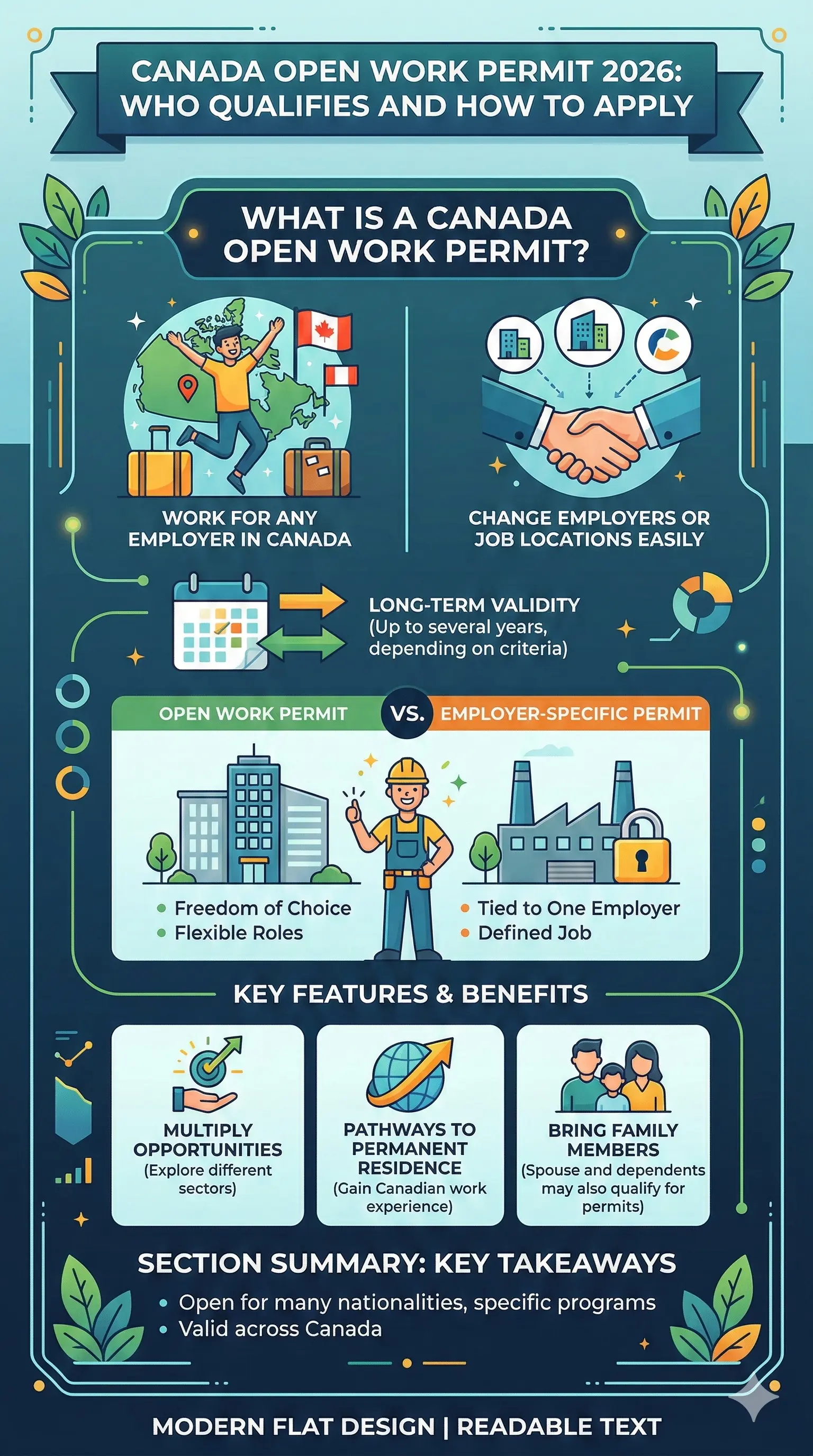
An open work permit lets you accept jobs from any employer in Canada, except those we've flagged as ineligible, like those involving sex work. Unlike employer-specific permits requiring a Labour Market Impact Assessment (LMIA), open permits prioritise flexibility for vulnerable groups, graduates, and families.
In 2026, amid reduced low-skilled Temporary Foreign Worker Program (TFWP) admissions and stricter extensions, open permits remain a lifeline for bridging to permanent residence (PR). They're LMIA-exempt, meaning no proof of Canadian worker shortages is needed, speeding up your start.
Key Benefits for 2026 Applicants
- Work anywhere, anytime—perfect for exploring opportunities in high-demand sectors like tech in Ontario or healthcare in B.C.
- Valid up to three years for post-graduation streams, with extensions possible if status allows.
- Family members often qualify too, supporting household stability during PR waits.
- No ties to one employer reduces abuse risks, a priority under our employment standards.
Who Qualifies for a Canada Open Work Permit in 2026?
Eligibility is category-specific, with stricter 2026 rules limiting spousal access to high-skilled workers (NOC TEER 0-3). You must meet general criteria: valid temporary status, sufficient funds, no criminal record, good health (medical exam if over six months), and ties to leave post-permit.
Principal Applicants Under TR to PR Pathway
If you're in Canada pursuing permanent residence via the Temporary Resident to Permanent Resident (TR to PR) pathway, you may qualify if you meet five key requirements:
- Reside in Canada with valid temporary status.
- Applied for PR under an eligible pathway before the deadline.
- Were legally authorised to work at PR application (valid work permit, exemption, or public policy).
- Met language benchmarks with approved test results (English/French as applicable).
- Intend to live outside Quebec (pathway-specific).
Applications are open until December 31, 2026—apply online to maintain status and work freely.
Family Members and Spouses
Spouses, common-law partners, or dependent children (18+) of principal TR to PR applicants qualify if the principal has applied under this policy. Beyond that:
- Spouses of international students or skilled workers (NOC TEER 0-3) in LMIA-exempt jobs.
- Family of RCIP/FCIP applicants with eligible job offers—LMIA-exempt if PR app passed completeness check.
- Dependents of refugees, vulnerable workers, or Atlantic Immigration Program participants.
Proof of relationship (marriage certificate, IMM 5707 form) is crucial; mismatches lead to refusals.
Graduates and Students
International graduates from Designated Learning Institutions (DLIs) qualify via Post-Graduation Work Permit (PGWP) if eligible—open permits allow full-time work off-campus. Destitute students unable to fund studies also apply.
Other Eligible Groups
- Vulnerable workers at risk of abuse with employer-specific permits.
- Refugees, claimants, protected persons, or those under unenforceable removal orders.
- IEC working holiday participants (country quotas apply).
- Temporary resident permit holders or Quebec investors with Notice of Intent.
Check IRCC's eligibility tool for your scenario.
How to Apply for Your Open Work Permit in 2026
Apply online via your IRCC account—most from inside Canada, some at ports of entry (not for visitors). Processing averages 4-6 months; start six months before expiry.
Step-by-Step Application Process
- Create or log into IRCC Portal: Gather passport, photos, and docs first.
- Confirm Eligibility: Use IRCC quiz; note fee exemptions for TR to PR.
- Prepare Documents: See table below for uploads.
- Pay Fees: $155 CAD (open work permit) + $100 CAD open permit holder fee; exemptions apply.
- Submit and Biometrics: Provide fingerprints/photos if needed ($85 CAD).
- Wait for Approval: Bridging Open Work Permits (BOWPs) maintain status during waits.
Required Documents Table
| Required Document | Upload Location |
|---|---|
| Fees receipt copy (or exemption proof) | Proof of fee exemption |
| Work authorisation proof at PR app | Client Information |
| Language test results | Client Information |
| PR pathway application proof | Client Information |
| Passport (all pages) | Passport |
| Digital photo | Digital photo |
| Family Information (IMM 5707) | Family Information Form |
| Police certificates, medicals, funds proof | Supporting docs |
Tip: Match NOC codes precisely (not job titles) and ensure docs validity. For RCIP/FCIP, include AOR, recommendation, and job offer via Employer Portal.
Common Pitfalls and Practical Tips
Avoid refusals by double-checking TEER levels for spousal eligibility—only NOC 0-3 now. Plan extensions early; volatile times hit 6+ months.
- Prove funds: Enough for you/family plus return travel.
- Health/criminal checks: Medical if >6 months; police certificates often required.
- Track status via IRCC account; use webform for queries.
- Canadians: Help relatives by verifying their status docs before sponsoring.
FAQ: Canada Open Work Permit 2026
1. Can visitors apply for an open work permit?
No, you need existing valid study/work status or fit specific categories like spouses/grads.
2. What's the difference from employer-specific permits?
Open permits allow any employer; specific ones tie you to one, often needing LMIA.
3. Do family members need their own applications?
Yes, but link to principal's; refusal if principal hasn't applied.
4. Are there fees for TR to PR open permits?
Fee-exempt, but biometrics may apply.
5. How long is it valid?
Up to permit expiry or PR decision; extensions via BOWP possible.
6. Can I work in Quebec?
Generally yes, but some pathways exclude it; check specifics.
Next Steps to Secure Your Open Work Permit
Start today: Run IRCC's eligibility quiz, gather docs, and apply online before deadlines like December 31, 2026. Consult a regulated immigration consultant if complex, and monitor canada.ca for updates. With precision paperwork and early planning, you'll be working freely across our provinces soon—building your Canadian future one shift at a time.