How to Hire Employees in Canada 2026: Payroll, ROE and Provincial Rules

Expanding your team in Canada? Hiring employees smoothly means mastering federal rules, provincial quirks, and the latest 2026 updates on payroll, ROE issuance, and compliance. Whether you're a small...
The Lifetimes Canada editorial team curates, fact-checks, and updates guides on personal finance, property, health, immigration, legal, business, and lifestyle topics relevant to Lifetimes Canada readers. Articles are produced with AI assistance and reviewed by the editorial team before publication.
Expanding your team in Canada? Hiring employees smoothly means mastering federal rules, provincial quirks, and the latest 2026 updates on payroll, ROE issuance, and compliance. Whether you're a small business owner in Ontario or scaling up in Alberta, this guide breaks down everything you need to hire confidently while staying on the right side of the law.
Understanding Canada's Hiring Landscape in 2026
Canada's job market is buzzing in 2026, with 55 per cent of employers planning to ramp up permanent hires in the first half of the year. Yet, challenges like skills gaps—cited by 53 per cent of hiring managers as tougher than last year—mean you must adapt smartly. Federal laws set the baseline, but provinces add layers: Ontario demands pay transparency, while Saskatchewan bans tip deductions.
Start by classifying your business. Federally regulated sectors like banking or telecom follow Canada Labour Code; most others stick to provincial employment standards. Always check your jurisdiction—rules differ across our 10 provinces and 3 territories.
Key 2026 Legislative Changes
- Ontario Transparency Rules: For jobs posted publicly, include salary ranges (up to $50,000 bands, exempt over $200,000), disclose AI use in hiring, note if it's an existing vacancy, and ban "Canadian experience" requirements. Notify interviewed candidates of decisions within 45 days.
- Prairie Provinces Leave Expansions: Alberta, Manitoba, and Saskatchewan now offer 27 weeks of long-term illness leave, aligning with federal standards. Saskatchewan adds 19 weeks maternity leave post-pregnancy loss and 16 weeks for interpersonal violence survivors (after 13 weeks' employment).
- Saskatchewan Tips: Employers can't deduct or withhold tips; wronged employees can seek repayment via the director of employment standards.
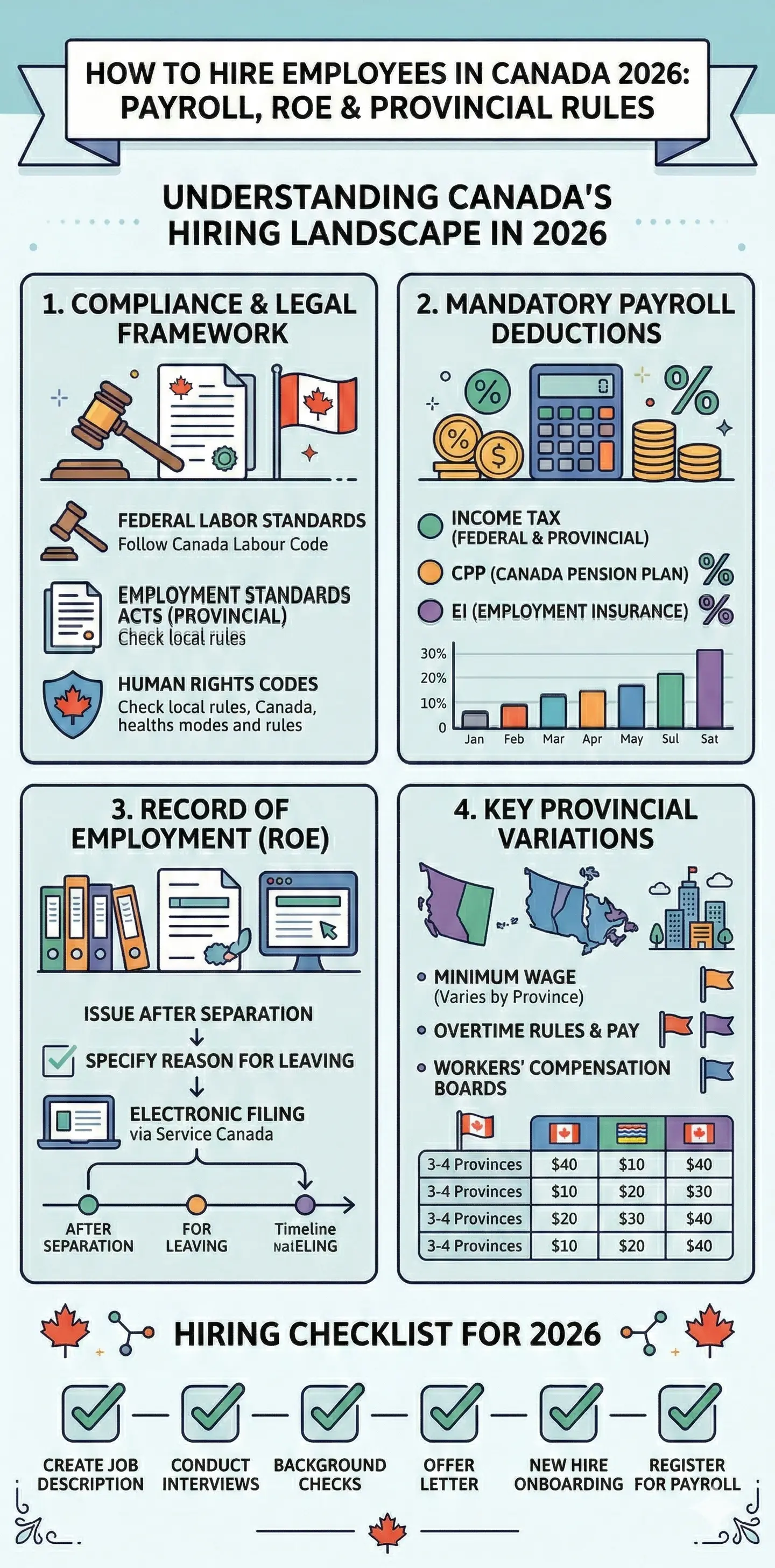
Step-by-Step Guide: How to Hire Employees Legally
Build a compliant process from job post to onboarding. Focus on fairness to dodge human rights complaints—prohibit discrimination on race, gender, age, disability, and more.
1. Craft Inclusive Job Postings
Your ad sets the tone. Use neutral language, highlight essential skills, and accommodate accessibility. In Ontario, meet new mandates or risk fines. Template tip: List duties clearly, required qualifications, and accommodations available.
2. Interview Best Practices
- Avoid questions on prohibited grounds like family status or wage history.
- Offer accommodations for disabilities.
- From 2026 in Ontario, follow up post-interview within 45 days.
Streamline with smaller panels, consecutive interviews, and pre-approved offers to speed things up amid talent shortages.
3. Offer Letters and Employment Contracts
Secure it in writing: include job title, duties, pay, hours, benefits, probation (if any), and termination terms. Tailor to province—e.g., British Columbia mandates specific notice periods. Use standard templates compliant with local laws.
4. Hiring Foreign Workers
Canada welcomes talent, with 2026-2028 plans stabilising at 380,000 permanent residents yearly, emphasising economic immigrants (64 per cent by 2027). For temps, secure a Labour Market Impact Assessment (LMIA) proving you couldn't find Canadians.
Work Permit Process:
- Check if LMIA needed (many roles exempt, like intra-company transfers).
- Apply via ESDC with recruitment proof.
- Employee applies for permit post-approval.
- Verify before start date; track renewals.
Accelerated paths exist for 33,000 temps transitioning to PR in 2026-2027 if rooted in communities.
5. Onboarding Essentials
Collect SIN, TD1 forms for tax, and provincial health cards. Provide policies on harassment, safety, and leaves. Train managers on compliance.
Payroll Setup: Getting It Right from Day One
Payroll isn't optional—it's your gateway to CRA compliance. Register for a payroll account via CRA's Business Registration Online (BRO) before the first paycheque.
Key Payroll Obligations
- Source Deductions: Withhold CPP (max $3,852.10 employee/employer in 2026), EI (max $1,207.92 employee), and federal/provincial taxes per TD1.
- Minimum Wage: Varies—e.g., $17.20/hour federally; Ontario $17.60 (2026 indexed); Alberta $15.50. Check annually.
- Equal Pay: Same work, same pay regardless of sex or protected grounds.
- Remittances: Pay CRA monthly/quarterly based on revenue; late fees sting.
Use software like Wagepoint or QuickBooks for automation. Record tips transparently, especially in Saskatchewan.
T-D4 and Year-End Filings
Issue T4 slips by February's end; file summaries with CRA. Errors trigger audits—double-check.
ROE: The Exit Ticket Every Employer Needs
Record of Employment (ROE) proves EI eligibility. Issue within 5 days of termination (or last pay for quits). Use web-based Service Canada portal—no paper forms.
When and How to Issue ROEs
- Mandatory: Last day worked or pay period end for interruptions over 7 days (e.g., layoff, quit, dismissal).
- Details: SIN, address, pay period, recall date if applicable, reason code (e.g., M for dismissal).
- 2026 Tip: Electronic ROEs auto-populate EI claims; keep records 6 years.
Wrong ROE? Amend via Service Canada to avoid EI overpayments you're liable for.
Navigating Provincial Rules
No one-size-fits-all here. Here's a snapshot:
| Province | Key 2026 Rules |
|---|---|
| Ontario | Pay ranges in ads, AI disclosure, 45-day interview notice. |
| Alberta/Sask./Man. | 27 weeks illness leave; Sask. tip protections. |
| Quebec | Official language rules in postings; unique labour code. |
| B.C. | Stricter termination pay; payroll sick leave expansions. |
Consult provincial ministries—e.g., Ontario's Working for Workers Acts drive changes.
Practical Tips for Success
- Train Your Team: Regular sessions on anti-discrimination and updates.
- Leverage Tech: AI screening? Disclose it. Video interviews speed hires.
- Flex on Skills: Prioritise potential over perfect matches amid gaps.
- Audit Regularly: Review postings, contracts yearly.
- Seek Help: Use CRA's payroll deduction calculator; consult lawyers for contracts.
FAQ
What if I hire a foreign worker without an LMIA?
Risk fines up to $100,000 and deportation orders. Always verify permits.
What's Ontario's new pay transparency rule?
Public ads must show salary bands (e.g., $60,000-$80,000) unless over $200,000.
When do I issue an ROE?
Within 5 days of employment interruption over 7 days. Use Service Canada online.
Does minimum wage change in 2026?
Yes, indexed annually—check your province (e.g., federal $17.20).
Can I require Canadian experience?
No, banned in Ontario job postings from 2026.
How do I handle tips in Saskatchewan?
No deductions; repay if withheld via employment standards director.
Next Steps to Hire with Confidence
Review your hiring docs today, register for payroll if needed, and bookmark provincial sites. For complex hires, partner with HR pros or immigration consultants. Stay updated via CRA and ESDC newsletters—compliant hiring builds a stronger team and business. Ready to post that job?