TFSA Limit 2026: Rules, Over-Contribution Penalties, and Best Investments
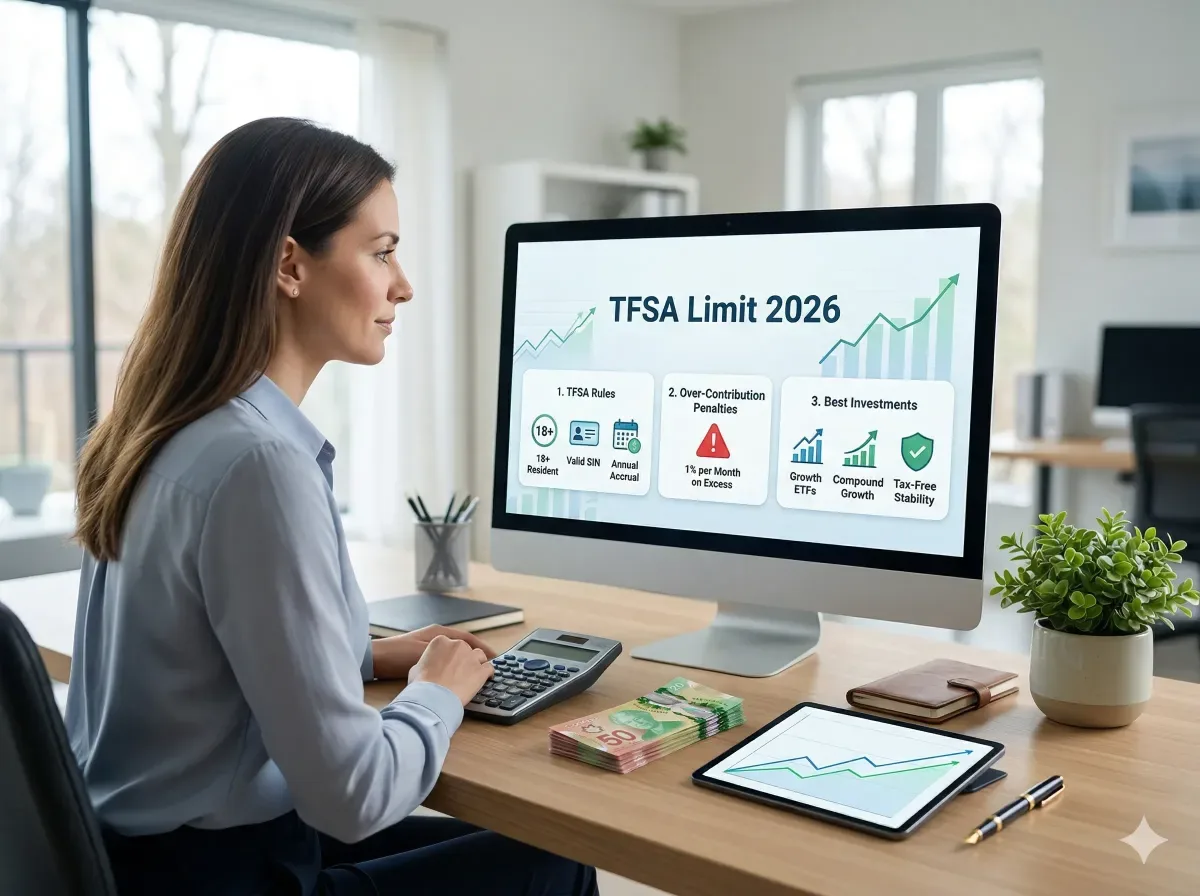
Imagine waking up on January 1, 2026, with an extra $7,000 of tax-free saving power at your fingertips. That's the reality for Canadians with a Tax-Free Savings Account (TFSA), where your 2026 contrib...
The Lifetimes Canada editorial team curates, fact-checks, and updates guides on personal finance, property, health, immigration, legal, business, and lifestyle topics relevant to Lifetimes Canada readers. Articles are produced with AI assistance and reviewed by the editorial team before publication.
Imagine waking up on January 1, 2026, with an extra $7,000 of tax-free saving power at your fingertips. That's the reality for Canadians with a Tax-Free Savings Account (TFSA), where your 2026 contribution room kicks in, building on years of unused space that could total $109,000 for long-time eligible savers.[1][2] Whether you're new to TFSAs or maximising your portfolio, understanding the rules, avoiding costly over-contributions, and picking smart investments can supercharge your financial future.
What is the TFSA Limit for 2026?
The annual TFSA dollar limit for 2026 is $7,000, added to your contribution room on January 1, 2026.[1] This matches the 2025 limit and reflects inflation adjustments by the federal government.
Your total available room isn't just this year's $7,000—it's a lifetime accumulation. If you've been eligible since TFSAs launched in 2009 (meaning you were 18 or older that year and a Canadian resident), the cumulative limit reaches $109,000 in 2026, assuming no prior contributions.[2][3] Unused room from previous years carries forward indefinitely.
How TFSA Contribution Room Accumulates
Your personal TFSA room includes:
- The current year's $7,000 limit (2026).[1]
- Any unused room from prior years.
- Withdrawals from the previous year, which replenish your room the following January 1.[2]
For example, if Moira checks her CRA account on January 1, 2026, and sees $20,500 available, that's her total room including the new $7,000—ready for tax-free growth.[1]
| Year | Annual Limit | Cumulative Limit (since 2009) |
|---|---|---|
| 2026 | $7,000 | $109,000 |
| 2025 | $7,000 | $102,000 |
| 2024 | $7,000 | $95,000 |
| 2023 | $6,500 | $88,000 |
| 2022 | $6,000 | $81,500 |
Note: Cumulative limits assume eligibility from 2009 and no contributions or withdrawals.[2]
Who Qualifies for TFSA Contribution Room?
You earn room starting the year you turn 18, as long as you're a Canadian resident with a valid SIN.[3][4] Non-residents don't accumulate new room during that time, but prior room remains available upon return.
Check your exact room via your CRA My Account—it's the most accurate source, as it tracks contributions, withdrawals, and adjustments automatically.[1][3]
TFSA Rules You Need to Know for 2026
TFSAs offer flexibility unmatched by RRSPs: contribute after-tax dollars, watch investments grow tax-free, and withdraw anytime without tax hits.[7] Unlike RRSPs, withdrawals don't count as income and fully restore your room next year.
Key Contribution and Withdrawal Rules
- Over-18 start: Room begins at age 18.[5]
- Multiple accounts allowed: Hold TFSAs at different institutions, but total contributions across all can't exceed your room.[7]
- Withdrawals: Tax-free anytime; add back to room January 1 of the following year.[2]
- Spousal TFSAs: You can't contribute to your spouse's TFSA—each has their own room.[1]
- Death: Room transfers to a successor holder or is taxable for beneficiaries.
Pro tip: Log into CRA My Account regularly or set up direct deposit notifications to stay on top of your room.[1]
Over-Contribution Penalties: What Happens if You Go Over?
Exceeding your TFSA room triggers a steep 1% per month penalty tax on the excess amount, calculated and paid monthly until corrected.[1] The CRA sends reminders, but it's your responsibility to monitor.
Avoiding and Fixing Over-Contributions
- Calculate precisely: Use CRA's online tool or My Account to confirm room before contributing.[1]
- Withdraw excess immediately: Pull out over-contributed funds plus gains to stop the penalty clock.
- Report and pay: File Form RC243 (TFSA Return) if penalties apply; late payments add interest.
Example: If you accidentally contribute $1,000 over your $7,000 limit, you'll owe $10 monthly (1% of $1,000) until withdrawn. Always double-check with CRA data—bank estimates can lag.[1]
Actionable advice: Set a calendar reminder for January 1, 2026, to review your CRA account before funding.[2]
Best TFSA Investments for 2026
TFSAs shine for tax-free growth on dividends, interest, and capital gains. Choose based on your risk tolerance, timeline, and goals—diversify across asset classes.[7]
Top Low-Risk Options
- High-Interest Savings Accounts (HISAs): Ideal for emergency funds; expect 3-4% rates in 2026 from banks like Tangerine.[7]
- GICs: Lock in 3-5% for 1-5 years; tax-free compounding beats taxable alternatives.
- Money Market Funds: Liquid, low volatility with yields around inflation.
Growth-Oriented Picks
- ETFs: Broad market like Vanguard S&P 500 or Canadian dividend ETFs—low fees, diversified exposure.
- Individual Stocks: Blue-chips in tech, energy, or banks for higher potential returns.
- Bonds and Fixed Income: Government or corporate bonds for steady income.
Practical Portfolio Tips
For a balanced 2026 TFSA:
- 30% fixed income for stability.
- 50% equities/ETFs for growth.
- 20% cash/HISAs for flexibility.
Rebalance annually. Use robo-advisors like Wealthsimple for hands-off management within your TFSA.[3] Remember, all gains are tax-free—maximise by holding long-term.
Next Steps to Maximise Your 2026 TFSA
Start by logging into CRA My Account today to tally your room. Contribute up to $7,000 early for full-year tax-free growth. Diversify into ETFs or GICs via your bank or broker. Track contributions meticulously to sidestep penalties.
This isn't personalised advice—consult a financial advisor or tax professional for your situation, especially with CRA rules evolving. Open or top up your TFSA now and watch your wealth compound tax-free.
Disclaimer: Tax laws change; verify with CRA and seek professional guidance before acting.
Frequently Asked Questions
Sources & References
-
1
Calculate your TFSA contribution room - Canada.ca — www.canada.ca
- 2
-
3
What is the TFSA limit for 2026? - Wealthsimple — www.wealthsimple.com
-
4
TFSA Contribution Limit 2026 | Sun Life Canada — www.sunlife.ca
- 5
-
6
2026 TFSA, RRSP, RESP Updates: Big Changes to Your Accounts! (YouTube) — www.youtube.com
-
7
What's the 2026 TFSA contribution limit? - Tangerine — www.tangerine.ca
Useful Tools
Related Articles
Registered Education Savings Plan (RESP) 2026: Maximizing the $7,200 CESG
If you're a parent or guardian in Canada, you've likely heard that a Registered Education Savings Plan (RESP) is one of the best ways to save for a child's post-secondary education. But did you know t...

RESP Withdrawals 2026: How to Pull Money Out Without Tax Penalties
Imagine the excitement of your child heading off to university or college, only to realise the RESP you've diligently built over years comes with strict rules on withdrawals. Getting it wrong could me...