Seniors Care in Canada 2026: Long-Term Care Costs and Government Help

As Canada's population ages, more families are facing tough decisions about seniors care. With long-term care costs rising and wait lists growing, understanding your options and government support in...
The Lifetimes Canada editorial team curates, fact-checks, and updates guides on personal finance, property, health, immigration, legal, business, and lifestyle topics relevant to Lifetimes Canada readers. Articles are produced with AI assistance and reviewed by the editorial team before publication.
As Canada's population ages, more families are facing tough decisions about seniors care. With long-term care costs rising and wait lists growing, understanding your options and government support in 2026 is crucial for planning ahead.
Understanding Seniors Care Options in Canada
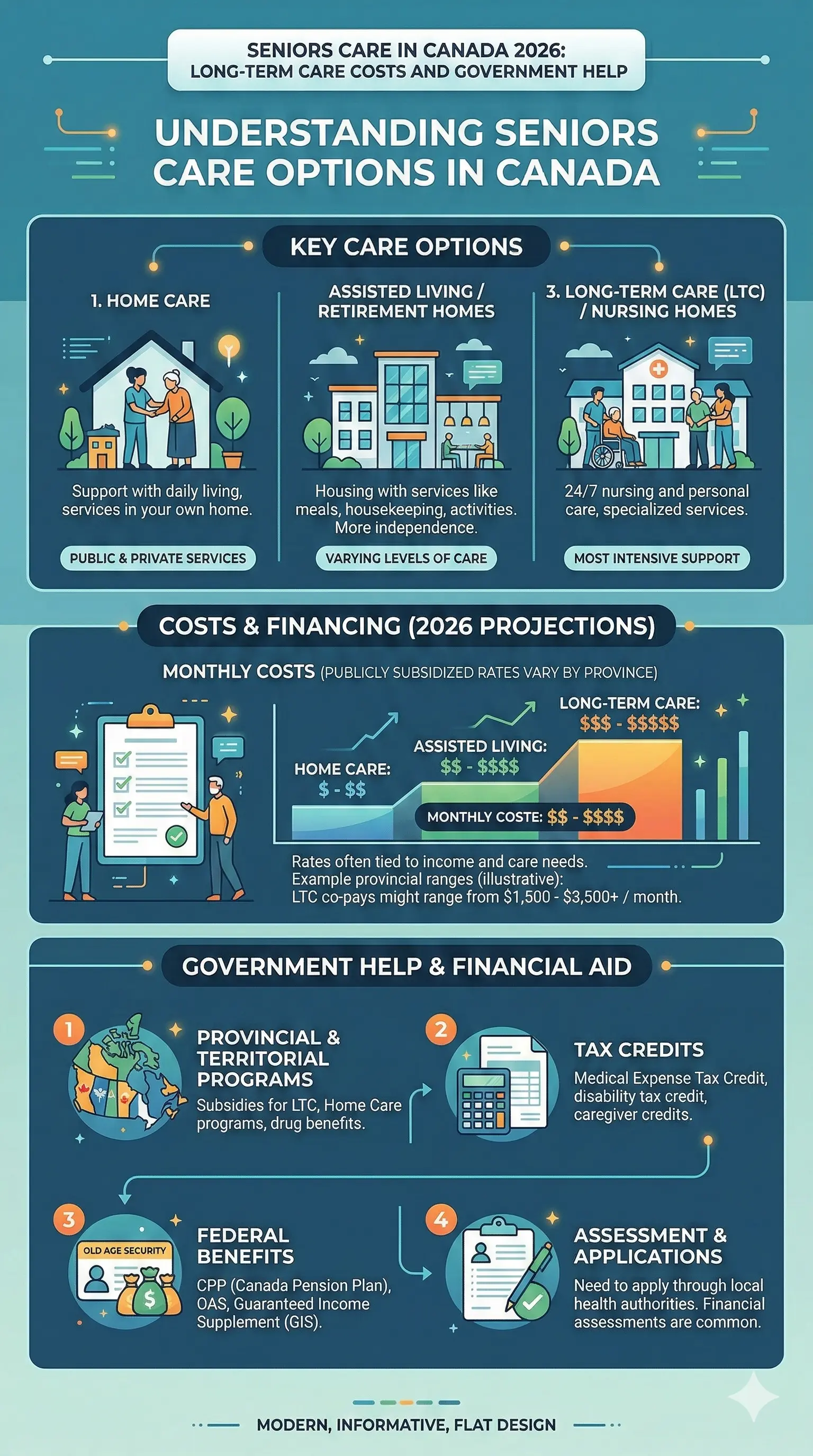
Seniors care in Canada ranges from in-home support to residential facilities. Long-term care (LTC) homes provide 24-hour nursing and personal care for those who can no longer live independently. Nearly half of Canadians in their late 80s will need LTC, yet fewer than one-third plan for it financially.
Home Care vs. Long-Term Care Homes
Home care lets seniors stay in familiar surroundings but can be pricey. Costs average $37 per hour or more, with moderate care (22 hours/week) exceeding $3,000 monthly and round-the-clock care nearing $30,000. LTC homes offer standardized care, often at lower relative costs for the services provided.
- Home care pros: Comfort of home, flexibility.
- Home care cons: High hourly rates, no 24/7 supervision.
- LTC pros: Full medical support, social activities.
- LTC cons: Wait lists, shared accommodations.
Private residential care bridges the gap, with costs from $1,600 to over $6,000 monthly depending on amenities.
Long-Term Care Costs in Canada 2026
Average LTC costs in subsidized homes range from $1,300 to $3,400 per month, while private facilities top $6,000. In Ontario, maximum resident fees are standardized: basic rooms around $2,000, private up to $2,800 monthly, covering care and meals.
Provincial Variations
Costs differ by province due to funding models. Ontario's 2025-2026 plan maintains a $1,500 per-bed pharmacy capitation rate and boosts staffing funding by 2% ($96.1 million increase). Nationally, demand strains supply—Canada needs 199,000 more LTC beds by 2035, at $64 billion capital and $130 billion operating costs.
| Accommodation Type | Average Monthly Cost (Subsidized) | Average Monthly Cost (Private) |
|---|---|---|
| Basic/Shared | $1,300–$2,000 | $1,600–$3,400 |
| Semi-Private | $1,800–$2,500 | $3,000–$5,000 |
| Private | $2,500–$3,400 | $5,000–$6,000+ |
Inflation and population growth (3% in 2024) push costs up, with total health spending hitting $399 billion in 2025 ($9,626 per Canadian). Expect similar trends into 2026.
Hidden Costs to Budget For
- Pharmacy and extras: Up to $150/month beyond basics.
- Move-in fees: One-time charges in private homes.
- Inflation adjustment: Plan for 4-5% annual rises.
Government Help for Seniors Care in 2026
Federal and provincial programs ease the burden. Most LTC basic costs are subsidized, with residents paying a co-pay based on income.
Federal Supports
- Old Age Security (OAS) and Guaranteed Income Supplement (GIS): Up to $720/month OAS (2026 rates) plus GIS for low-income seniors. Apply via Service Canada.
- Canada Pension Plan (CPP): Average $760/month; enhances affordability.
- New Home Care Strategy: Funds in-home services to delay LTC entry.
Provincial Programs
Ontario invests $4.9 billion (2020-2025) for staffing, targeting 4 hours daily direct care. Other provinces offer similar:
- BC: Subsidized Assisted Living, income-tested fees.
- Alberta: Continuing Care Assessment for eligibility.
- Quebec: CHSLD homes with sliding-scale fees.
Recent budgets face criticism for LTC pauses, urging families to check provincial sites.
Financial Assistance Eligibility
Co-pays max out at 100% of income after shelter allowance. Use provincial calculators—e.g., Ontario's LTC fee estimator on ontario.ca.
"The government remains committed to increasing long-term care staffing supply."
Planning Ahead: Practical Tips for Canadians
Start early to avoid surprises. Here's actionable advice:
Assess Needs Early
Get a needs assessment from your provincial health authority. In Ontario, contact Local Health Integration Networks (LHINs, now Home and Community Care Support Services).
Financial Strategies
- RRSP/TFSA: Withdraw tax-efficiently for care costs.
- Veterans Benefits: VAC covers eligible vets.
- Private Insurance: LTC policies cover gaps; shop via Canadian Life and Health Insurance Association.
- Downsize home equity via reverse mortgages or HELOCs.
Reduce Costs
Opt for subsidized beds (wait lists average 6-12 months). Community programs like Adult Day Centres delay full LTC.
FAQ: Seniors Care in Canada 2026
1. How much will LTC cost me in 2026?
Subsidized: $1,300–$3,400/month; private up to $6,000+. Fees are income-based.
2. Who qualifies for government-subsidized LTC?
Seniors needing 24/7 care, assessed provincially. Priority for complex needs.
3. Can I afford home care instead?
Moderate care: $3,000+/month at $37/hour. Government funds some hours via provincial programs.
4. What's new in 2026 budgets?
Ontario holds pharmacy rates steady, boosts staffing by 2%. Watch for federal updates.
5. How do I apply for assistance?
Contact provincial ministry (e.g., ontario.ca/long-term-care) or Service Canada for OAS/GIS.
6. Are wait lists improving?
Progress in staffing, but demand grows. Ontario targets 4 hours care/day.
Next Steps for Your Family
Don't wait—review finances today. Speak to a financial advisor about RRSP/TFSA strategies, get a care assessment, and explore local resources. Visit canada.ca/en/services/benefits/publicpensions or your province's health site. With planning, you'll secure quality care without breaking the bank.