How to Start a Business in Canada 2026: Sole Proprietor vs Incorporated

Dreaming of launching your own venture in Canada? Whether you're eyeing a simple side hustle or a scalable enterprise, choosing between a **sole proprietorship** and an **incorporated company** shape...
The Lifetimes Canada editorial team curates, fact-checks, and updates guides on personal finance, property, health, immigration, legal, business, and lifestyle topics relevant to Lifetimes Canada readers. Articles are produced with AI assistance and reviewed by the editorial team before publication.
Dreaming of launching your own venture in Canada? Whether you're eyeing a simple side hustle or a scalable enterprise, choosing between a **sole proprietorship** and an **incorporated company** shapes your path to success in 2026. This guide breaks down the key differences, steps, costs, and considerations tailored for Canadians, helping you decide what's right for your business goals.
Understanding Business Structures in Canada
Canada offers flexible options for entrepreneurs, but **sole proprietorship** and **incorporation** stand out as the most common for startups. A sole proprietorship is the simplest—you're the business, with no legal separation between you and your operations. Incorporation creates a distinct legal entity, offering protection and growth potential. Your choice impacts taxes, liability, setup costs, and compliance, especially under 2026 regulations from the CRA and provincial registries.
Sole Proprietorship: The Quick Start Option
As a **sole proprietor**, you own and run the business personally. It's ideal for freelancers, consultants, or low-risk ventures like graphic design or e-commerce from home. No formal incorporation means minimal paperwork, but you're personally liable for debts and lawsuits.
- Pros: Easy setup (often online in 20 minutes), low fees ($60–$80 in most provinces), full control, and pass-through taxation on your personal return.
- Cons: Unlimited personal liability, harder to raise capital, and business ends if you do.
In Ontario, register via ServiceOntario; in BC, use BC Registry Services. If using a trade name, search for availability first.
Incorporation: Building for Growth and Protection
Choosing to **incorporate** forms a separate legal entity—either provincially or federally. This shields your personal assets from business liabilities, making it suitable for higher-risk industries like tech or retail. Federal incorporation (under the Canada Business Corporations Act) allows nationwide operations, while provincial suits local focus.
- Pros: Limited liability, easier funding (e.g., investors prefer shares), perpetual existence, and tax benefits like the small business deduction (9% federal rate on first $500,000 active income).
- Cons: Higher setup costs ($200–$250 fees plus legal), ongoing filings, and separate corporate taxes.
No minimum share capital required federally or provincially, lowering barriers for startups. For federal corps, at least one director must be Canadian-resident in some cases, though provinces like Ontario and BC have dropped this.
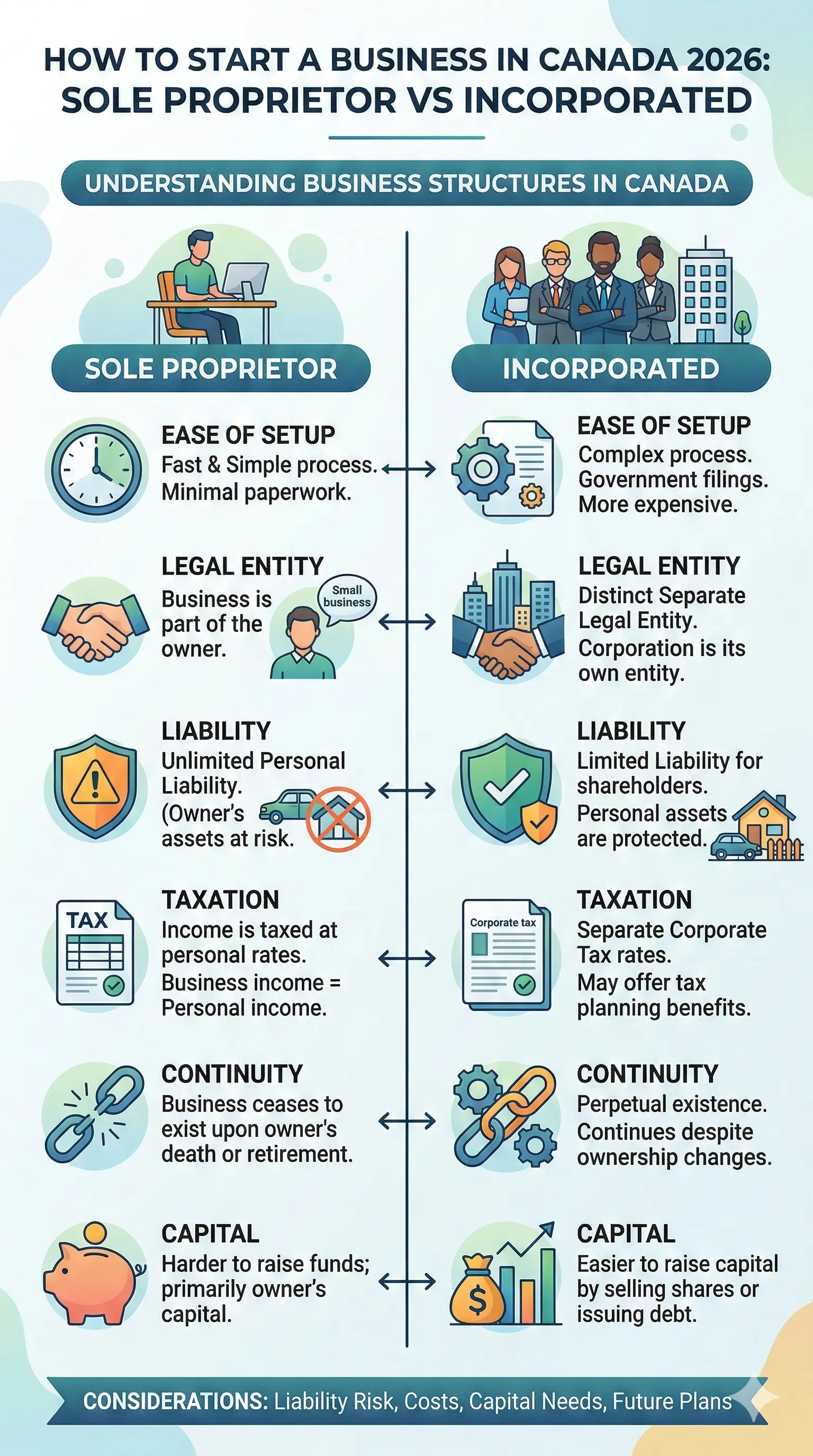
Sole Proprietor vs Incorporated: Key Comparisons
Here's a side-by-side look to help you compare based on 2026 realities:
| Aspect | Sole Proprietorship | Incorporated (Federal/Provincial) |
|---|---|---|
| Setup Time & Cost | 20 minutes, $60–$80 | Days to weeks, $200–$250 + legal fees |
| Liability | Unlimited personal | Limited to investment |
| Taxes | Personal rates (up to 53% combined) | Corporate (9–15% small business rate) + personal dividends |
| Raising Capital | Personal loans/savings | Shares, investors, grants |
| Ongoing Compliance | Minimal (BN, GST if >$30k) | Annual returns, extra-provincial registration |
| Best For | Solopreneurs, low-risk | Teams, scaling, liability protection |
Sole props suit bootstrappers; incorporation fits ambitious plans with employees or investors.
Step-by-Step: How to Start a Sole Proprietorship in Canada 2026
- Validate Your Idea: Research market via StatCan data and competitors. Use BizPaL to check provincial licenses.
- Choose & Register Name: Use your legal name or register a trade name (NUANS search for uniqueness, ~$20).
- Get Business Number (BN): Register with CRA online for free—adds GST/HST (RT), payroll (RP) accounts if needed. Mandatory if revenue hits $30,000.
- Open Bank Account: Separate personal/business finances; most banks require BN and ID.
- Provincial Registration: Online portals like ServiceOntario or BC Registry (~$60–$80).
- Licenses & Permits: Municipal (e.g., Toronto home permit $75), zoning, health for food/salons.
- Insurance & Taxes: Get liability coverage; file personal T1 with business income (Schedule T2125).
Total startup cost: under $200. You're operational in days.
Step-by-Step: How to Incorporate Your Business in Canada 2026
- Decide Federal vs Provincial: Federal for multi-province; provincial for local (e.g., Ontario $300–$360).
- Name Search: NUANS report ($20–$75) for availability.
- Prepare Documents: Articles of Incorporation, bylaws, initial directors. Use online services or lawyers (~$500+).
- File Incorporation: Online via provincial registries or Corporations Canada ($200 federal fee). Get Certificate of Incorporation.
- Get BN & Program Accounts: CRA registration for corp taxes, GST if applicable.
- Registered Office: Physical Canadian address (not P.O. box); virtual options ~$100/year.
- Extra-Provincial: Register in other provinces (e.g., Ontario 60 days).
- Banking & Compliance: Open corporate account (needs Articles, BN); file annual returns.
Expect $500–$2,000 total, including legal help. Directors' meetings and records required.
Taxes, Funding, and Compliance in 2026
Both structures need CRA BN. Sole props report on personal taxes; corps file T2 returns. Claim input tax credits on GST/HST early. RRSP/TFSA contributions offset personal taxes. For funding, sole props use personal credit; corps attract investors via shares—no minimum capital.
2026 updates: Small business deduction caps first $500,000 at 9% federal. Provinces like Alberta/BC offer entrepreneur streams with $100,000–$200,000 investments for immigration, but Canadians focus on grants via Canada.ca.
Practical Tips for Canadians
- Project revenue: Register GST early if over $30k.
- Home-based? Check zoning—Toronto needs $75 permit.
- Employees? Set up payroll (RP account), EI/CPP remittances.
- Consult free CRA webinars or provincial small business centres.
Next Steps to Launch Your Business
Assess your risk, growth plans, and budget—sole prop for simplicity, incorporation for security. Start with a CRA BN and name search today. Use free tools like BizPaL for permits, and book a free consult with a provincial advisor. Track 2026 deadlines for GST and filings to stay compliant. Your Canadian dream business awaits—get registered and thrive!
Frequently Asked Questions
Sources & References
-
1
Canada Entrepreneur Immigration 2026: Active PNP Business Requirements — www.amirismail.com
- 2
- 3
-
4
How to Start a Business in Canada Efficiently as a Foreigner — www.commenda.io
-
5
Canada Start-Up Visa 2026: Update, Eligibility, Process, & Costs — www.globalcitizensolutions.com
- 6
-
7
Start-up Visa Program - Canada.ca — www.canada.ca
-
8
Immigrate with a start-up visa: Who can apply - Canada.ca — www.canada.ca