GST/HST in Canada 2026: Registration, Filing and Input Tax Credits Explained
Running a business in Canada means navigating the GST/HST system, a value-added tax that touches nearly every transaction. Whether you're a sole proprietor in Toronto launching an online store or a gr...
The Lifetimes Canada editorial team curates, fact-checks, and updates guides on personal finance, property, health, immigration, legal, business, and lifestyle topics relevant to Lifetimes Canada readers. Articles are produced with AI assistance and reviewed by the editorial team before publication.
Running a business in Canada means navigating the GST/HST system, a value-added tax that touches nearly every transaction. Whether you're a sole proprietor in Toronto launching an online store or a growing enterprise in Vancouver hitting revenue milestones, understanding GST/HST in Canada 2026 ensures compliance, cash flow efficiency, and access to valuable input tax credits (ITCs).
In 2026, with rates steady at 5% GST federally plus provincial HST portions (up to 15% in Ontario and Atlantic provinces), getting registration, filing, and ITCs right avoids penalties from the CRA while maximising refunds on business expenses. This guide breaks it down step-by-step with practical tips tailored for Canadian businesses.
Understanding GST/HST Basics for 2026
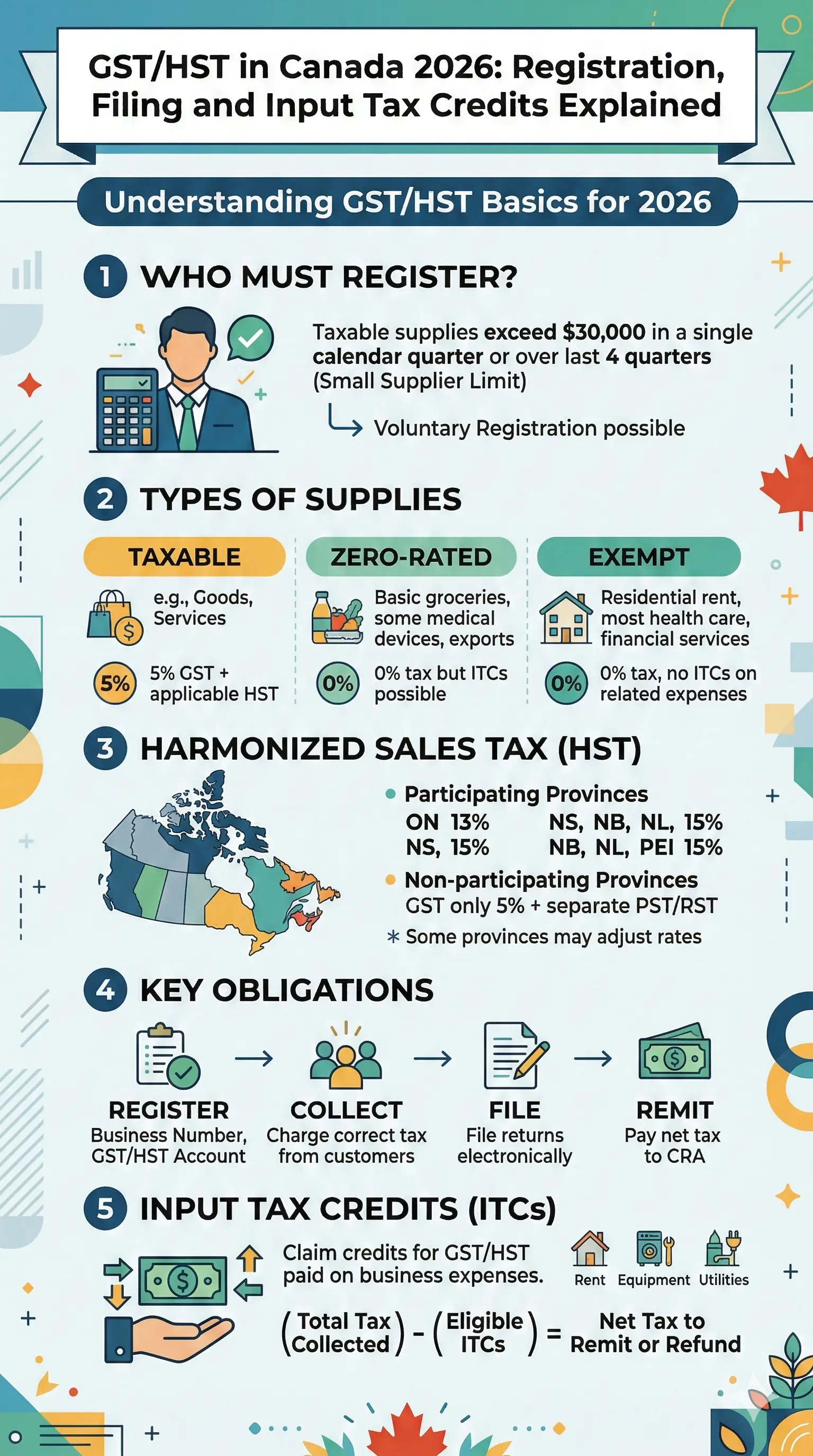
GST/HST stands for Goods and Services Tax/Harmonised Sales Tax, applied to most goods and services sold in Canada. The federal GST is 5%, while HST combines this with provincial sales tax in participating provinces like New Brunswick, Newfoundland and Labrador, Nova Scotia, Ontario, and Prince Edward Island. Other provinces apply GST plus separate provincial sales tax (PST), such as 7% PST in British Columbia.
For 2026, key rates remain unchanged: Ontario HST at 13%, Atlantic provinces at 15%, and Quebec at 9.975% QST plus 5% GST. Businesses charge GST/HST on taxable supplies—everything from consulting services to physical products—but exempt supplies like basic groceries or medical services don't attract it.
Who Needs to Worry About GST/HST?
If you're providing taxable supplies in commercial activities, you're likely involved. Small suppliers (under $30,000 in worldwide taxable supplies over four consecutive calendar quarters) can often skip registration, but voluntary registration unlocks ITCs. Exceptions apply: taxi operators, ride-sharing drivers, and digital economy businesses must register regardless of threshold.
- Digital businesses: Non-residents selling digital products (e.g., software downloads) or services to Canadians register under simplified GST/HST if over $30,000 CAD annually.
- Non-residents: Those without a permanent establishment in Canada may need a security deposit.
- Voluntary registrants: Ideal for claiming ITCs on expenses even if under threshold.
GST/HST Registration: When and How in 2026
Registration is mandatory if you're not a small supplier and make taxable supplies in Canada. The $30,000 threshold is calculated over the last four quarters or any single quarter plus prior three—not calendar year sales. Exceed it? Your effective registration date is no later than the day of your first supply after becoming non-small, and you must register within 29 days.
Step-by-Step Registration Process
- Gather info: Business name, address, type (sole prop, corporation), owner SINs, major activities, and expected revenue. Sole proprietors use SIN; corporations may have an existing BN.
- Obtain a Business Number (BN): Use CRA's Business Registration Online or Form RC1. Your GST/HST account becomes 123456789RT0001 format.
- Register online: Via CRA My Business Account. Effective date is request date for voluntary, or up to 30 days prior.
- Start charging: From your effective date, add GST/HST to invoices.
Tip for Canadians: New businesses in Alberta or BC? Factor provincial taxes separately post-registration. Use CRA's GST/HST calculator for accuracy.
Special Cases in 2026
- Ride-sharing (e.g., Uber in Montreal): Register immediately upon starting—day one is your effective date.
- Digital platforms: Airbnb hosts or Netflix-style services use simplified regime if eligible, no ITCs but easier filing.
- Non-residents: Over $30,000 to Canadian consumers? Register under normal or simplified regime.
Filing Your GST/HST Returns: Frequencies and Deadlines
Once registered, filing frequency depends on revenue:
| Filing Frequency | Revenue Threshold | Return Due | Payment Due |
|---|---|---|---|
| Annual | Up to $1.5M | 3 months after FY-end | Same |
| Quarterly | $1.5M-$6M | 1 month after quarter-end | Same |
| Monthly | Over $6M | 1 month after month-end | Same |
| Simplified Annual | Under $400K (selected) | 3 months after FY-end | Quarterly instalments |
File electronically via NETFILE or mail. Report net tax: collected GST/HST minus ITCs. Late filing? Penalties up to 5% plus interest.
Filing Tips for Efficiency
- Quick Method: For small businesses under $400,000, remit a flat percentage of sales—no ITC tracking needed.
- instalments: CRA may require if owing over $3,000 previously.
- Example: Toronto retailer with Q1 sales $500,000 collects $65,000 HST (13%). After $40,000 ITCs, remit $25,000 by April 30.
Input Tax Credits (ITCs): Recover Your Costs
ITCs are the GST/HST you pay on business purchases, reclaimable to avoid tax-on-tax. Eligible? 90%+ business use, paid to GST/HST registrants.
Claiming ITCs Step-by-Step
- Keep records: Invoices with supplier BN, date, amount, tax breakdown—for 6 years.
- Calculate: Full ITC if 90-100% business; pro-rate otherwise (e.g., car 60% business use = 60% ITC).
- Report on return: Line 108 for total ITCs. Excess? Refund or carry forward.
- Digital businesses: Simplified regime bars ITCs—opt for normal if expenses high.
2026 Update: No major ITC changes, but enhanced CRA audits mean meticulous records pay off. Claim vehicle fuel in Manitoba? PST portion ineligible.
Common ITC Pitfalls to Avoid
- Personal expenses: Non-deductible.
- Mixed-use assets: Track usage logs.
- Capital assets: ITCs over time if depreciated.
Practical Tips for GST/HST Compliance in 2026
- Software help: QuickBooks or CRA-certified tools automate calculations.
- Province-specific: Saskatchewan PST registrants file separately.
- Audit prep: Segregate exempt/taxable sales.
- New business: Register voluntarily early for ITCs on startup costs like computers.
FAQ: GST/HST in Canada 2026
Q: What's the exact $30,000 threshold calculation?
A: Taxable supplies over four quarters or one quarter + prior three. Worldwide for residents; Canadian for simplified non-residents.
Q: Can I cancel registration if sales drop?
A: Yes, if small supplier again and no taxable supplies owing. Apply via CRA.
Q: Do exports qualify for zero-rating?
A: Yes, zero-rate exports (charge 0%, claim ITCs).
Q: What's simplified GST/HST for?
A: Digital/platform businesses under $1M—no ITCs, annual filing.
Q: Penalties for non-compliance?
A: 1% of unremitted tax per month, plus late-filing fines.
Q: How do RRSP purchases factor in?
A: Personal RRSP contributions exempt; business financial services may qualify for ITCs.
Next Steps for Your Business
Review your last four quarters' sales against $30,000. Not registered? Use CRA's online tool today. Track expenses for ITCs and set reminders for deadlines. For complex setups like multi-province operations, consult a CPA or tax advisor—rules evolve, and this isn't personalised advice.
Stay compliant, claim every credit, and keep more in your pocket. Questions? CRA's Business Enquiries line at 1-800-959-5525.