Crypto Tax Canada 2026: How CRA Treats Bitcoin, ETH and NFT Gains

As cryptocurrency continues to reshape our financial landscape, many Canadians are wondering how to handle their Bitcoin, Ethereum, and NFT investments come tax time. With the CRA ramping up oversight...
The Lifetimes Canada editorial team curates, fact-checks, and updates guides on personal finance, property, health, immigration, legal, business, and lifestyle topics relevant to Lifetimes Canada readers. Articles are produced with AI assistance and reviewed by the editorial team before publication.
As cryptocurrency continues to reshape our financial landscape, many Canadians are wondering how to handle their Bitcoin, Ethereum, and NFT investments come tax time. With the CRA ramping up oversight in 2026, understanding crypto tax Canada 2026 rules is essential to avoid penalties and stay compliant.
Whether you've traded Bitcoin for ETH, sold an NFT, or earned staking rewards, every transaction could trigger a tax event. This guide breaks down exactly how the CRA treats these assets, with practical steps tailored for Canadians filing in 2026.
How the CRA Classifies Cryptocurrency
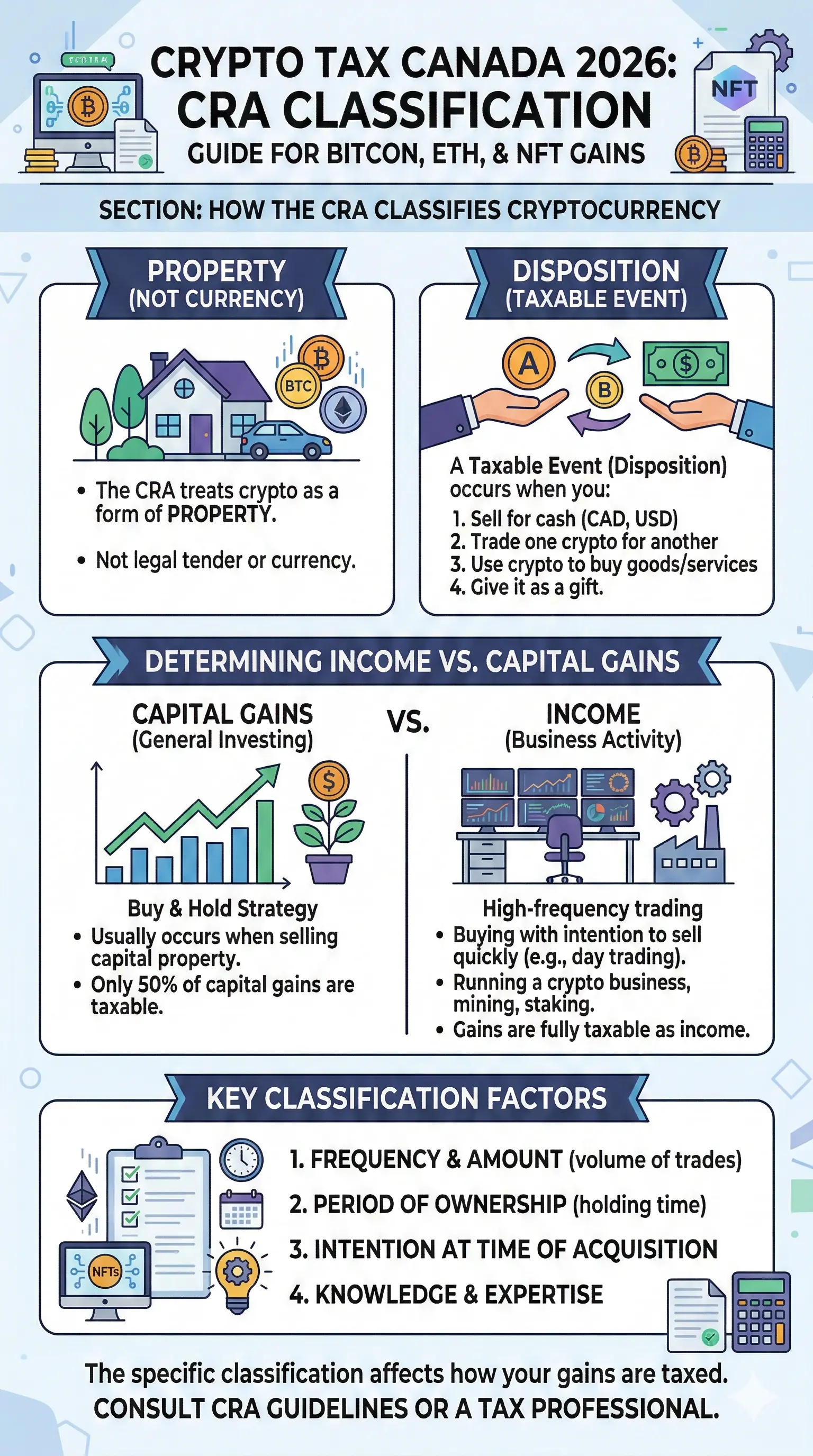
The Canadian Revenue Agency (CRA) views cryptocurrency not as legal tender, but as a commodity, similar to gold or oil. This means Bitcoin, ETH, and NFTs fall under capital gains or business income rules, depending on your activity.
For most investors, buying and holding crypto qualifies as a capital transaction. Frequent trading or mining, however, might be deemed business income. The key distinction? Your intent and frequency of trades.
Capital Gains vs. Business Income: Key Differences
| Aspect | Capital Gains Treatment | Business Income Treatment |
|---|---|---|
| Typical Activity | Long-term investing, occasional trades | Frequent trading, mining, staking as business |
| Taxable Portion | 50% of gains (standard); 66.67% on gains over $250,000 | 100% of income |
| Loss Treatment | Offset capital gains only; carry back 3 years or forward indefinitely | Offset any income |
| Reporting Form | Schedule 3 | T2125 (Statement of Business Activities) |
Use this table to classify your activity. If you're unsure, track your trades and consult a tax professional—misclassification is a top CRA audit trigger.
Taxable Events for Bitcoin, ETH, and NFTs
Any disposition of crypto triggers a tax event, calculated using the fair market value in CAD at the time of the transaction. Here's what counts:
- Selling Bitcoin or ETH for CAD
- Trading BTC for ETH (or any crypto-to-crypto swap)
- Using crypto to buy goods, services, or NFTs
- Gifting crypto (deemed disposition at FMV)
- Earning staking rewards, airdrops, or mining income
- Selling or trading NFTs for profit
Bitcoin and ETH: Standard Capital Gains
For Bitcoin and Ethereum holders, most trades are capital gains. Calculate your gain as: Proceeds (FMV at sale) minus Adjusted Cost Base (ACB, your original cost plus fees).
Example: You bought 1 BTC for $50,000 CAD. Sell it in 2026 for $100,000 CAD. Gain = $50,000. Taxable portion: 50% = $25,000, taxed at your marginal rate (15-33% federal, plus provincial).
Losses? Only 50% is deductible against capital gains, not other income.
NFTs: Treated Like Other Crypto Assets
NFTs follow the same rules—taxed on sale, trade, or use. Buying an NFT with ETH? Both the ETH disposition and NFT acquisition need tracking at FMV.
Creators earning royalties? That's 100% business income. High-value NFT flips could push you into the $250,000+ capital gains bracket with a 2/3 inclusion rate.
2026 Tax Rates and Changes
Canada has no flat crypto tax rate. Your bill depends on total income, province, and gains type. Federal rates range 15-33%; add provincial (e.g., Ontario up to 13.16%). Half of capital gains (or 2/3 over $250,000) adds to taxable income.
New in 2026: Stricter reporting for crypto-asset service providers (CASPs). All fiat-crypto and crypto-crypto trades must be reported, including your name, address, and DOB. Exchanges already report over $10,000; now it's comprehensive.
Deadline: April 30, 2026 (June 15 for self-employed). File early from February. Can't pay with Bitcoin—use CAD via CRA's online portal.
How to Calculate and Report Crypto Taxes
- Track Everything: Use ACB method (average cost of identical assets). Tools like CoinLedger or Koinly integrate with exchanges.
- Calculate Gains/Losses: FMV out - ACB in. Halve for capital gains.
- Report: Schedule 3 for gains; T2125 for business. Include GST/HST if applicable.
- File: Via NETFILE or tax software. Keep records 6+ years.
Practical Tip: Export CSV from exchanges like Coinbase or Binance Canada. Reconcile with blockchain explorers for DeFi/NFT trades.
Reducing Your Tax Bill Legally
- Hold long-term for capital gains treatment.
- Offset gains with losses (e.g., sell losers first).
- Contribute to RRSP/TFSA (crypto inside TFSA? Gains tax-free, but risky).
- Donate crypto—get FMV credit, avoid gain tax.
"Crypto transactions are a lot more traceable than people think. The CRA can use exchange data, blockchain analysis tools and international data-sharing agreements to spot inconsistencies."
Common Pitfalls and CRA Audits
Avoid these 2026 traps:
- Forgetting crypto-to-crypto trades.
- Wrong forms (Schedule 3 vs. T2125).
- Ignoring staking/mining income (100% taxable).
- Poor records—no ACB proof triggers reassessments.
CRA audits are rising; penalties up to 50% of tax owing plus interest.
FAQ: Crypto Tax Canada 2026
1. Is crypto taxable in Canada?
Yes, as a commodity—capital gains on 50% of profits or 100% income.
2. Do I pay tax on every crypto trade?
Yes, including crypto-to-crypto. Use FMV in CAD.
3. How are NFTs taxed?
Same as crypto: gains on sale/trade/gifts.
4. Can I use crypto losses against salary?
No, only against capital gains.
5. What's new for 2026 reporting?
CASPs report all trades + customer info.
6. Do I need a crypto tax calculator?
Recommended—handles ACB and complex trades.
Next Steps for Compliant Filing
Gather your exchange statements, calculate ACB, and use CRA-certified software. If your portfolio exceeds $50,000 or involves DeFi/NFTs, hire a crypto-savvy accountant. We're not tax advisors—consult a professional or visit CRA for personalized advice.
Stay ahead: Bookmark CRA's crypto guide and enable 2FA on accounts. File by April 30, 2026, to avoid penalties. Your compliant returns keep more CAD in your wallet.