Truck Accident Lawyer Canada 2026: Why Commercial Claims Pay More
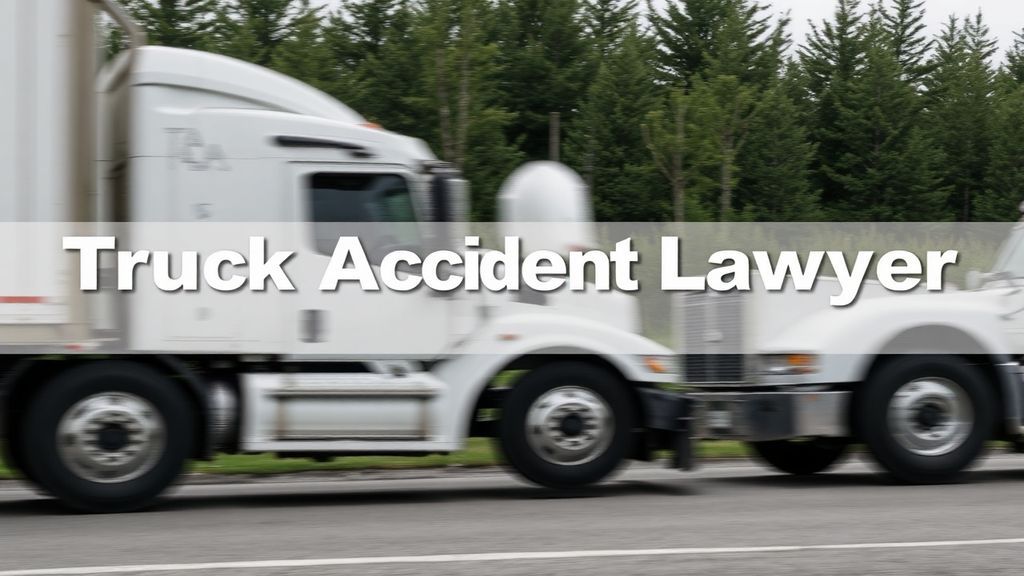
Learn why commercial truck accidents result in higher settlements, the impact of black-box evidence, and how Canadian laws apply to semi-truck injury claims in 2026.
The Lifetimes Canada editorial team curates, fact-checks, and updates guides on personal finance, property, health, immigration, legal, business, and lifestyle topics relevant to Lifetimes Canada readers. Articles are produced with AI assistance and reviewed by the editorial team before publication.
Picture driving down Ontario's Highway 401, Alberta's Queen Elizabeth II (QEII) Highway, or navigating the steep grades of British Columbia's Coquihalla. You are sharing the road with 80,000-pound commercial trucks. While the vast majority of transport operators are highly trained professionals, when things go wrong, the results are almost always catastrophic. If you or a loved one have been involved in a collision with a transport truck, you quickly realise that this isn't just a standard car accident. It's a highly complex legal battle.
Hiring a truck accident lawyer in Canada is significantly different from hiring a lawyer for a standard fender bender. In 2026, the regulatory landscape, insurance minimums, and evidentiary requirements make a commercial vehicle accident lawyer an absolute necessity. Commercial claims consistently pay out more than passenger vehicle claims, but securing that payout requires navigating a labyrinth of federal regulations, provincial insurance laws, and aggressive corporate defence teams. Here's exactly why semi-truck injury claims are valued higher and how you can protect your rights.
Why Commercial Truck Claims Pay Out Significantly More
When you are struck by a fully loaded tractor-trailer, the physical forces involved are astronomical compared to a standard car crash. Because the damages are higher, the financial compensation must reflect that reality. However, it isn't just about the severity of the injuries; it's about the deep pockets and high insurance policies backing commercial trucking operations.
Higher Mandatory Insurance Policy Limits
In Canada, standard passenger vehicles often carry a minimum liability coverage of $200,000 (though most drivers opt for $1 million to $2 million). Commercial transport trucks, on the other hand, are required by federal and provincial laws to carry significantly higher minimum liability coverage [1]. Depending on the province, the type of freight being hauled, and whether the truck crosses the US-Canada border, trucking companies routinely carry policies ranging from $5 million to $10 million, or even more for hazardous materials.
Because the policy limits are vastly higher, there is a much larger pool of funds available to compensate victims for lifelong medical care, lost earning capacity, and severe pain and suffering. A seasoned truck accident lawyer knows how to identify all active insurance policies, including umbrella policies that cover the trucking corporation.
Catastrophic Injuries and Lifelong Care
Statistics Canada data consistently shows that collisions involving heavy commercial vehicles have a much higher likelihood of resulting in catastrophic injuries or fatalities [2]. Injuries often include traumatic brain injuries (TBIs), spinal cord damage leading to paralysis, severe burns, and multiple complex fractures.
In a semi-truck injury claim, the calculation for future care is immense. If you are unable to work for the rest of your life, require modifications to your home, and need round-the-clock nursing care, your claim could quickly venture into the multi-million dollar range. A commercial vehicle accident lawyer will work with medical experts, occupational therapists, and economists to calculate the precise lifetime cost of your injuries down to the last cent.
The Web of Liability: Pursuing Multiple Defendants
In a typical car crash, you are usually dealing with one at-fault driver and their insurance company. A commercial truck accident is rarely that simple. A major reason commercial claims pay more is that your legal team can often hold multiple parties legally and financially responsible. This legal concept is known as vicarious liability and joint liability.
The Truck Driver
The individual behind the wheel is the most obvious defendant. If they were speeding, driving aggressively, or operating the vehicle while fatigued or impaired, they are directly liable for their negligence.
The Trucking Company (Motor Carrier)
Trucking companies are generally responsible for the actions of their employees while on the job. Furthermore, the company can be held independently liable for negligent hiring practices, failing to properly train their drivers, or forcing drivers to meet unrealistic deadlines that encourage speeding and hours-of-service violations.
Freight Loaders and Shippers
If a truck rolls over on a curve on the Coquihalla Highway, it might not be entirely the driver's fault. If the cargo was improperly loaded or not secured correctly by a third-party shipping centre, the shifting weight can easily cause a rollover or jackknife. Your lawyer will investigate the cargo manifests to determine if the loading company shares the blame.
Manufacturers and Maintenance Providers
Commercial trucks require rigorous maintenance. If a brake failure caused a rear-end collision on an Alberta highway, liability might fall on the third-party mechanic company that recently serviced the brakes, or the manufacturer of a defective truck part.
The Crucial Role of Black-Box Evidence and ELDs
One of the most significant advantages you have when pursuing a commercial claim in 2026 is the sheer volume of digital evidence available. Modern commercial trucks are highly digitised machines.
Since Transport Canada mandated Electronic Logging Devices (ELDs) for commercial motor vehicles [3], drivers can no longer easily falsify paper logbooks to hide hours-of-service violations. If a driver was fatigued and legally required to be resting, the ELD will prove it.
Furthermore, commercial trucks are equipped with an Electronic Control Module (ECM), commonly referred to as a 'black box'. A skilled truck accident lawyer will immediately send a spoliation letter to the trucking company, legally preventing them from destroying or overriding this data. The ECM can tell your legal team:
- The exact speed the truck was travelling prior to impact
- Whether the brakes were applied, and at what pressure
- The engine RPM and throttle position
- Whether cruise control was engaged
- GPS location and steering angles
When you have indisputable digital evidence proving the truck driver's reckless behaviour, corporate insurance companies are far more likely to offer a substantial settlement to avoid a devastating loss in court.
Navigating Provincial Differences: Ontario, BC, and Alberta
While federal regulations govern inter-provincial trucking, personal injury and auto insurance laws are handled at the provincial level. Where your accident occurs dramatically changes how your claim is handled.
Ontario: SABS and the Tort System
If you are hit by a truck in Ontario, you will deal with a hybrid system. You will apply for Statutory Accident Benefits (SABS) through your own insurer for immediate medical and rehabilitation needs [4], regardless of fault. However, for a commercial truck crash causing severe injuries, your lawyer will also file a tort claim (a lawsuit) against the at-fault driver and the trucking company for pain and suffering, lost wages not covered by SABS, and future healthcare costs.
British Columbia: The Enhanced Care Model
BC operates under the ICBC Enhanced Care (no-fault) model, which severely limits the ability to sue an at-fault driver for standard crashes. However, commercial claims can be unique. If the trucking company is based outside of BC, if the crash happened outside of BC boundaries, or if the driver is convicted of a criminal offence (such as dangerous driving causing bodily harm), there may still be avenues to pursue a traditional tort claim. Even within the ICBC system, a lawyer is vital to ensure you receive the maximum allowable permanent impairment and care benefits.
Alberta: The Grid and Catastrophic Exceptions
Alberta caps pain and suffering damages for 'minor injuries', but injuries from a semi-truck crash rarely fall into this category. If you suffer a severe injury on Alberta's highways, you are fully entitled to sue for damages well beyond the cap. Alberta's robust tort system allows your legal team to aggressively pursue the trucking corporation for full compensation.
What to Do After a Collision with a Semi-Truck
If you are involved in a commercial truck collision, taking immediate action is critical to protecting your future claim. While your health is always the absolute priority, you or a family member should try to secure the scene.
First, call 911. Police reports are heavily scrutinised in commercial accidents, and officers will often conduct detailed commercial vehicle inspections at the scene. Second, take extensive photographs of the vehicles, skid marks, road conditions, and any commercial logos or Department of Transportation (DOT) numbers on the truck's cab and trailer. Finally, seek immediate medical attention, even if you feel fine. Adrenaline masks severe trauma, and documented medical records are the foundation of your injury claim.
Why You Must Act Quickly
Trucking companies deploy rapid response teams. Within hours of a major crash, corporate investigators and insurance adjusters are dispatched to the scene to mitigate their liability. They will attempt to control the narrative, interview witnesses, and occasionally try to pressure victims into early, lowball settlements.
You need someone in your corner who understands commercial vehicle laws and has the resources to fight back. In Canada, you generally have a two-year limitation period to file a personal injury lawsuit, but waiting even a few weeks can result in crucial evidence (like black-box data or dashcam footage) being overwritten or 'lost'.
A dedicated truck accident lawyer will instantly level the playing field. They will handle the aggressive insurance adjusters, secure the physical and digital evidence, and build a comprehensive case designed to force the maximum possible payout. Don't let a corporate trucking company dictate your recovery; demand the compensation you deserve to rebuild your life.
Frequently Asked Questions
Sources & References
-
1
Transport Canada - National Safety Code for Motor Carriers — tc.canada.ca
-
2
Statistics Canada - Motor vehicle collisions and transport accidents — www150.statcan.gc.ca
-
3
Transport Canada - Electronic Logging Devices (ELD) Mandate — tc.canada.ca
- 4