First-Time Home Buyer Guide Canada 2026: FHSA, RRSP and Down Payment Rules
Buying your first home in Canada in 2026 is an exciting milestone, but navigating the rules around down payments, savings plans like the FHSA and RRSP, and incentives can feel overwhelming. This guide...
The Lifetimes Canada editorial team curates, fact-checks, and updates guides on personal finance, property, health, immigration, legal, business, and lifestyle topics relevant to Lifetimes Canada readers. Articles are produced with AI assistance and reviewed by the editorial team before publication.
Buying your first home in Canada in 2026 is an exciting milestone, but navigating the rules around down payments, savings plans like the FHSA and RRSP, and incentives can feel overwhelming. This guide breaks it down into clear steps, with practical tips tailored for Canadians to help you save smarter, qualify easier, and close confidently.
Understanding Down Payment Rules for First-Time Buyers in 2026
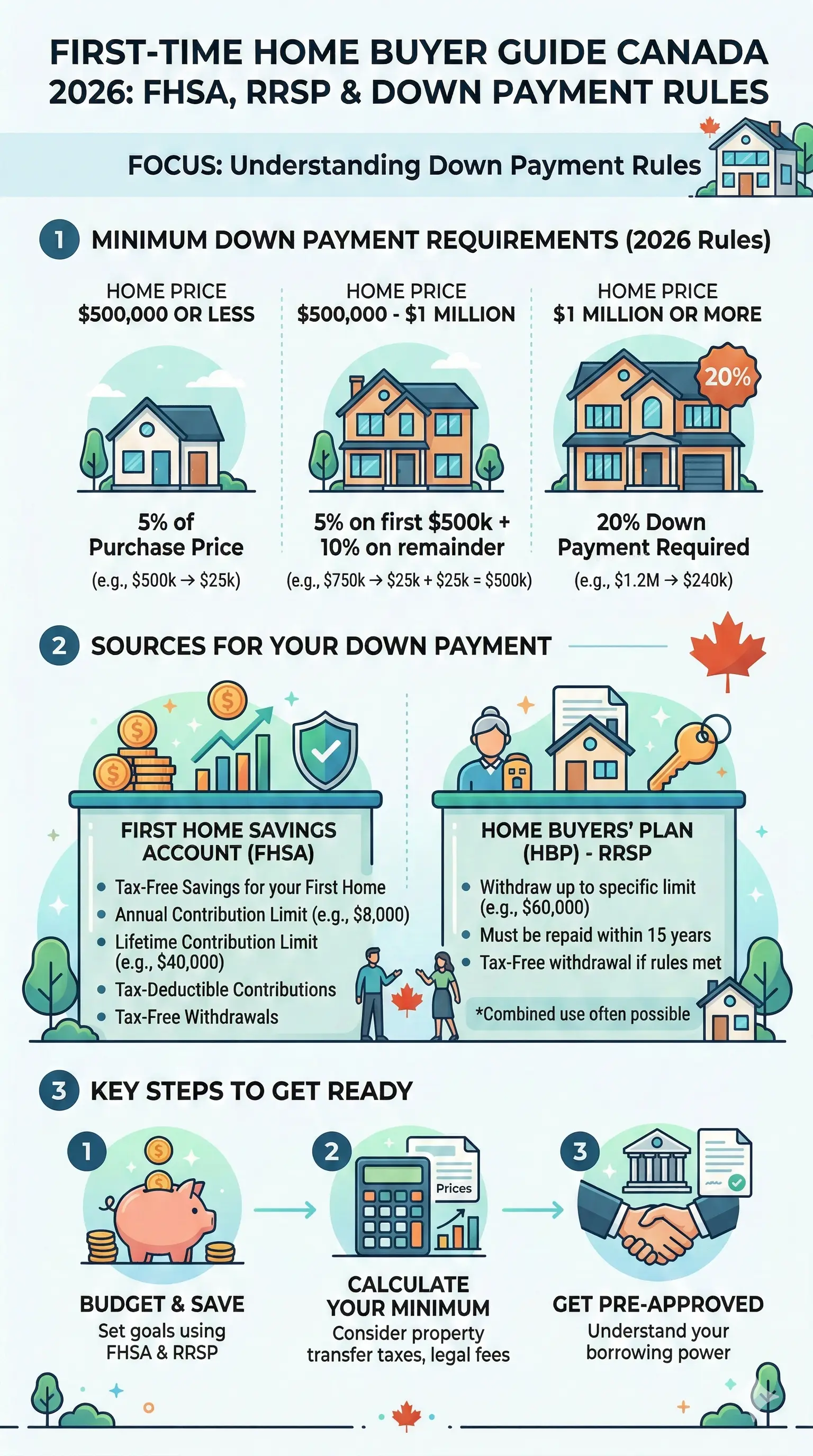
The minimum down payment requirements haven't changed much, but they're tiered based on your home's purchase price to make entry-level buying more accessible. For homes under $500,000, you'll need just 5% down; for the portion between $500,000 and $1.5 million, it's 10%; and 20% for anything over $1.5 million. Saving more than the minimum can reduce your monthly payments and avoid costly mortgage default insurance, but it's not always necessary for the best rates.
Why Mortgage Default Insurance Matters
If your down payment is less than 20%, you'll pay for CMHC or similar insurance—typically 2.8% to 4% of the mortgage amount, plus provincial taxes like 6-9% PST in Ontario or Quebec. In 2026, there's also a 0.20% surcharge for amortizations over 30 years, so aim for shorter terms if possible to keep costs down.
- Tip: Use online calculators from CMHC to estimate your insurance premiums before house hunting.
- Provinces like Ontario offer first-time buyer rebates on land transfer taxes up to $4,000, which can offset these costs.
Leveraging the First Home Savings Account (FHSA) in 2026
The FHSA is a game-changer for first-time buyers: contribute up to $8,000 annually (lifetime limit $40,000), claim tax deductions on contributions, and withdraw tax-free for your home purchase. It's like a supercharged TFSA designed specifically for this goal, and you can hold it for 15 years or until your first home purchase.
How to Maximise Your FHSA
- Open an FHSA at your bank or investment platform—it's quick and available to anyone 18-71 who qualifies as a first-time buyer.
- Contribute consistently; employer matches or spousal contributions can boost it further.
- Combine with RRSP for even more firepower—many buyers use both to hit 20% down without depleting emergency savings.
"FHSA: Tax-deductible contributions going in, tax-free withdrawals coming out for your first home purchase."
RRSP Home Buyers' Plan (HBP): Borrow from Your Future Without Penalty
Through the HBP, you can withdraw up to $60,000 tax-free from your RRSP for a down payment, with 15 years to repay. No immediate taxes hit, but missed repayments become taxable income—so set up automatic contributions to stay on track.
Eligibility and 2026 Updates
You qualify if you (and your spouse) haven't owned a home in the last four years and intend to live in it as your primary residence. Recent separations may restore eligibility after 90 days apart. In 2026, pair this with FHSA for up to $100,000 in tax-advantaged funds combined.
- Pro Tip: Repay strategically—start small if cash flow is tight, but prioritise to avoid CRA penalties.
- Check CRA's portal for your HBP balance anytime.
Other Government Incentives and Provincial Perks
Beyond FHSA and HBP, grab the First-Time Home Buyers' Tax Credit for up to $1,500 in non-refundable relief. New builds qualify for GST/HST rebates, and provinces sweeten the deal:
| Province | Benefit |
|---|---|
| Ontario | Land Transfer Tax Refund up to $4,000 |
| Newfoundland and Labrador | 50% grant on closing costs + 5% repayable loan |
| Prince Edward Island | Full land transfer tax rebate under $200,000 |
| Montréal (Quebec) | Up to $15,000 lump sum for new homes |
Always confirm with your province's housing ministry, as 2026 budgets may tweak these.
Step-by-Step Home Buying Process in 2026
Follow this proven framework to avoid pitfalls:
Step 1: Get Mortgage Pre-Approval
Shop rates and lock in pre-approval—it's free and shows sellers you're serious. Lenders check income, credit, and debt ratios; newcomers need immigration proof.
Step 2: House Hunt Smartly
Team up with a Realtor, shortlist via MLS, and view properties. Define must-haves: neighbourhood, size, budget.
Step 3: Make a Strong Offer
Include conditions for financing, inspection ($500-$1,500), and appraisal. Negotiate like a pro—2026's market may favour buyers with more inventory.
Step 4: Closing Day Essentials
Budget 1.5-4% of purchase price for extras: legal fees, title insurance, prorated taxes, utility hookups ($150-$300 each). Bring a bank draft for down payment and costs.
After Closing
- Update addresses with CRA, Service Canada (for SIN, CPP), and utilities.
- Change locks, deep clean, and connect services.
- Track ongoing costs: mortgage, taxes, insurance, condo fees if applicable.
Hidden Costs and Budgeting Tips
Don't get caught short—closing costs alone can hit thousands. Factor in movers, packing, minor repairs, and first month's utilities. Use this checklist:
- Mortgage default insurance: 2.8-4%
- Legal fees: $1,000-$2,000
- Home inspection: $500-$1,500
- Land transfer taxes (pre-rebate)
- Adjustments for property taxes/utilities
Actionable Advice: Build a 3-6 month emergency fund post-purchase, and review your budget with tools from Ratehub or CMHC.
Your Next Steps to Homeownership
Start today: Open an FHSA, get pre-approved, and connect with a local Realtor. Track progress with CMHC's step-by-step worksheets, and consult CRA for personalised tax advice. With these tools, you're set to join Canada's homeowners in 2026—affordably and stress-free.
Frequently Asked Questions
Sources & References
-
1
First-Time Home Buyer Guide Canada 2026 — yourhomeinottawa.ca — yourhomeinottawa.ca
-
2
First-Time Home Buyer Programs in Canada in 2026 — ratehub.ca — www.ratehub.ca
-
3
Buying A Home In 2026 | Step By Step Guide — youtube.com — www.youtube.com
-
4
First-Time Home Buyer Mortgage Guide — nesto.ca — www.nesto.ca
- 5
-
6
Home Buying Step by Step — cmhc-schl.gc.ca — www.cmhc-schl.gc.ca
- 7
-
8
Buying a House in 2026? Here's What to Expect — nerdwallet.com/ca — www.nerdwallet.com
-
9
Six Government of Canada programs to support homebuyers in 2026 — lowestrates.ca — www.lowestrates.ca