FHSA Canada 2026: The First Home Savings Account Fully Explained

Dreaming of owning your first home in Canada but struggling to save in today's high-cost housing market? The First Home Savings Account (FHSA) could be your game-changer, blending RRSP tax deductions...
The Lifetimes Canada editorial team curates, fact-checks, and updates guides on personal finance, property, health, immigration, legal, business, and lifestyle topics relevant to Lifetimes Canada readers. Articles are produced with AI assistance and reviewed by the editorial team before publication.
Dreaming of owning your first home in Canada but struggling to save in today's high-cost housing market? The First Home Savings Account (FHSA) could be your game-changer, blending RRSP tax deductions with TFSA-style tax-free withdrawals to supercharge your down payment.
Launched a few years ago, the FHSA has gained massive traction by 2026, helping thousands of Canadians like you get closer to homeownership. Whether you're in Toronto's competitive market or a smaller city, understanding how to maximise this account in 2026 is key. We'll break down eligibility, limits, strategies, and more with practical tips tailored for our Canadian landscape.
What is the FHSA?
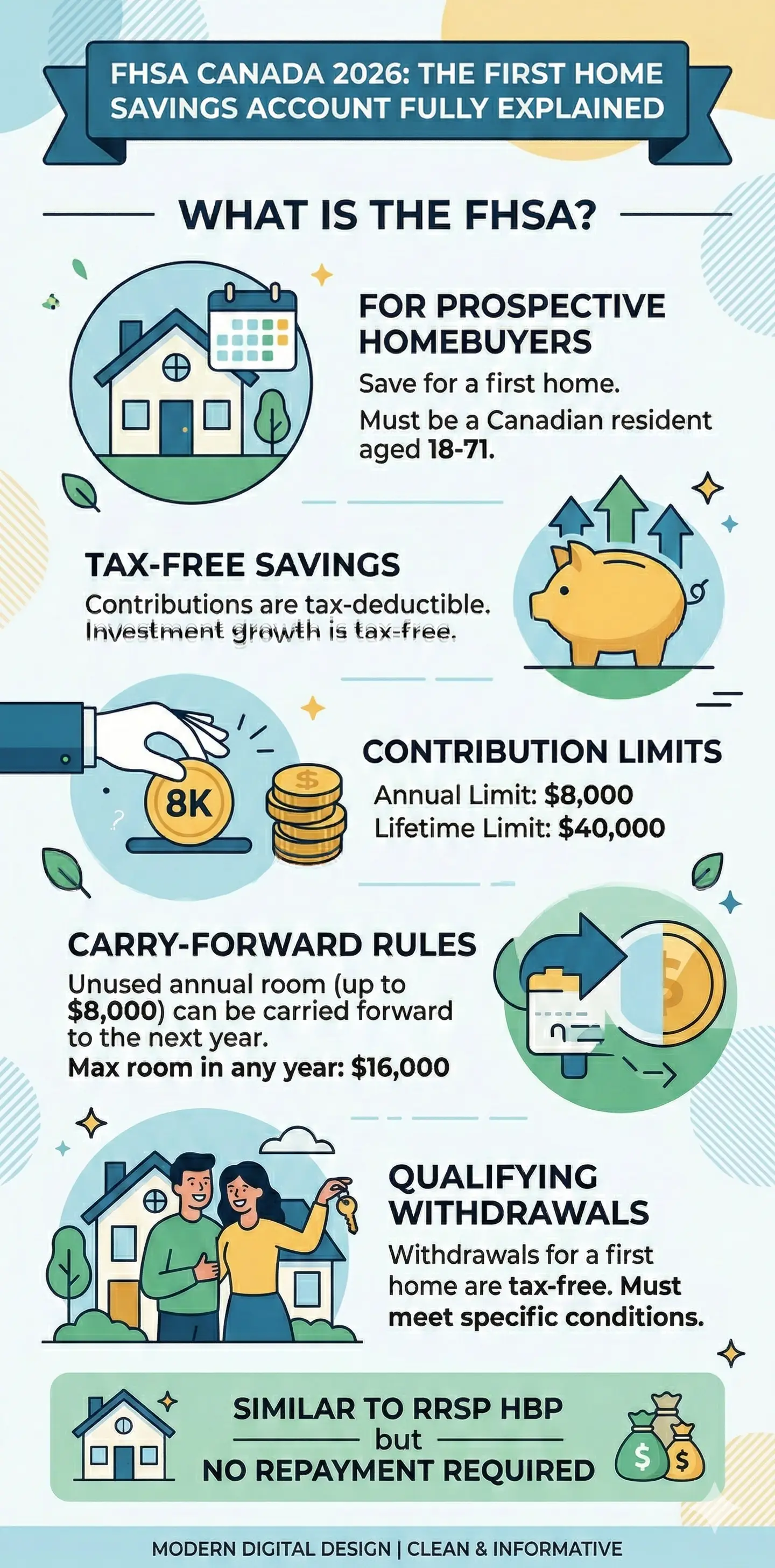
The FHSA, or First Home Savings Account, is a registered savings plan designed specifically for first-time home buyers in Canada. It lets you contribute up to set limits annually, claim tax deductions on those contributions (like an RRSP), and withdraw funds tax-free for a qualifying home purchase (like a TFSA).
Unlike the RRSP Home Buyers' Plan (HBP), which requires repayment, FHSA withdrawals for your first home are permanent and tax-free—no strings attached. Investments inside grow tax-free too, making it a powerful tool amid rising home prices across provinces from B.C. to Ontario.
How the FHSA Differs from RRSPs and TFSAs
- RRSP: Tax-deductible contributions, but growth and withdrawals are taxable unless under HBP (which must be repaid).
- TFSA: Tax-free growth and withdrawals, but no upfront tax deduction on contributions.
- FHSA: Best of both—deduct contributions now, withdraw tax-free later for your home.
This hybrid structure means you could save thousands in taxes while building your nest egg efficiently.
Who is Eligible for an FHSA in 2026?
To open an FHSA, you must tick these boxes:
- Be a Canadian resident.
- At least 18 years old (or 19 in provinces/territories where that's the age of majority, like B.C. or Ontario).
- First-time home buyer: You (or your spouse/common-law partner) haven't owned and lived in a qualifying home in the current year or the past four calendar years.
- Not turning 72 or older in the year you open it.
First-Time Buyer Examples
Consider Aysha, who co-owned a home in 2021 (her principal residence) and sold it in 2024. She can't open an FHSA until 2029 because the four-year window overlaps. Meanwhile, Carlos lives in a home owned by his common-law partner—he's ineligible too.
But if you're renting or living with family without ownership, you're likely good to go. Check your status via CRA's guidelines.
FHSA Contribution Limits for 2026
In 2026, the rules stay steady: $8,000 annual limit and $40,000 lifetime cap. Unused room from prior years carries forward indefinitely, so if you only put in $2,000 in 2025, you can contribute up to $14,000 in 2026 ($8,000 new + $6,000 carryover).
Couples? Each can open their own FHSA—double the savings power for joint buyers. You can hold multiple FHSAs, but the $40,000 lifetime limit applies across all.
Key Contribution Rules
- Room starts accruing only after opening your FHSA—no retroactive contributions.
- Contributions made January 1 to December 31 count for that tax year. Unlike RRSPs, first-60-days contributions don't deduct from the prior year.
- Transfers from RRSPs to FHSA are allowed (up to limits) but not tax-deductible.
- Overcontributions? 1% monthly tax penalty until fixed.
| Year | Annual Limit | Max with Carryover (Example) |
|---|---|---|
| 2025 | $8,000 | $8,000 |
| 2026 | $8,000 | $16,000 (if $0 in 2025) |
| Lifetime | - | $40,000 |
How to Open and Manage Your FHSA
Contact banks, credit unions, or insurers like Scotiabank, RBC, or Fidelity to open one—it's straightforward online or in-branch. Once open:
- Invest in eligible assets: GICs, mutual funds, ETFs (similar to RRSP/TFSA).
- Track room via CRA My Account.
- Account stays open up to 15 years or end of year you turn 71, whichever first.
Pro Tip: Start early—even $200/month compounds nicely with tax-free growth.
Tax Benefits and Withdrawals
Contributions reduce your taxable income, potentially saving you 20-50% in taxes depending on bracket. Growth is tax-sheltered.
Qualifying Withdrawals
Withdraw tax-free if:
- Buying/building a qualifying home in Canada (detached, condo, mobile home, etc.).
- Written agreement by October 1 next year; occupy as principal residence within 1 year.
- You're a first-time buyer at withdrawal time.
Close FHSA by December 31 next year after first withdrawal—no reopening later. Non-qualifying? Taxed as income + 30% penalty (waivable in hardship).
Practical Strategies for 2026
- Max carryover: If behind, use 2025/2024 room for a big 2026 contribution post-tax refund.
- Couple sync: Both contribute $8,000+ for $100K+ combined savings potential.
- Invest aggressively: Balance stocks/ETFs for growth, shift to GICs near purchase.
- Combine with HBP: FHSA + HBP = up to $70K+ tax-free for down payment.
- Monitor housing rebates: Pair with GST/HST new home rebate.
In Vancouver or Calgary? These limits help combat median prices over $800K.
FHSA FAQ
Can I have more than one FHSA?
Yes, but total lifetime limit is $40,000 across all.
Is FHSA income-tested?
No—eligibility hinges on homeownership status, not income.
What if I don't buy a home?
Non-qualifying withdrawals are taxable + penalty. Or transfer to RRSP (if room).
Can I contribute after age 71?
No—must close by end of year you turn 71.
Spouse owns a home—am I eligible?
No, if it's your principal residence.
2026 changes?
No major updates—limits and rules consistent.
Next Steps to Launch Your FHSA Today
Ready to save smarter? Log into CRA My Account to confirm eligibility, then shop issuers for low-fee options. Contribute your first $8,000 this year and watch tax savings + growth work for you. Consult a financial advisor for personalised advice, especially with 2026 tax filing around the corner. Your first home is closer than you think—start now.