Landlord Insurance Canada: What Rental Property Owners Must Have

Imagine discovering water damage throughout your rental property after a tenant's forgotten faucet causes a flood, or facing a lawsuit because a visitor slips on an icy walkway you didn't clear. These...
The Lifetimes Canada editorial team curates, fact-checks, and updates guides on personal finance, property, health, immigration, legal, business, and lifestyle topics relevant to Lifetimes Canada readers. Articles are produced with AI assistance and reviewed by the editorial team before publication.
Imagine discovering water damage throughout your rental property after a tenant's forgotten faucet causes a flood, or facing a lawsuit because a visitor slips on an icy walkway you didn't clear. These scenarios aren't rare for Canadian landlords, and without the right protection, they can wipe out your investment overnight. Landlord insurance in Canada is your essential shield, tailored specifically for rental properties unlike standard homeowner policies.
In this guide, we'll break down what landlord insurance Canada covers, why rental property owners must have it, and how to choose the best policy for 2026. Whether you're in Ontario, British Columbia, or anywhere else, understanding these details helps safeguard your income and assets.
Why Landlord Insurance is Essential for Rental Property Owners
Standard homeowner insurance doesn't cut it for rentals. It's designed for owner-occupied homes, leaving landlords exposed if they use it for tenants. Landlord insurance, a type of business insurance, protects the building structure, your income, and liability risks specific to renting out properties.
While not legally mandated across Canada, mortgage lenders almost always require it to protect their investment in your property. Even without a mortgage, skipping it risks massive losses—think tens of thousands in repairs from fire, theft, or tenant damage. In 2026, with rising property values and repair costs, it's a non-negotiable for protecting your rental income stream.
Key Differences: Landlord Insurance vs. Homeowner Insurance
- Occupancy: Homeowner policies assume you live there; landlord policies cover tenant-occupied dwellings.
- Coverage Scope: Landlord insurance includes loss of rental income and fair rental value if the unit becomes uninhabitable.
- Liability: Enhanced protection for injuries on your property, crucial under provincial tenancy laws.
Landlord insurance fills gaps that could otherwise lead to financial ruin, especially since it doesn't cover tenant belongings—that's on them via renters insurance.
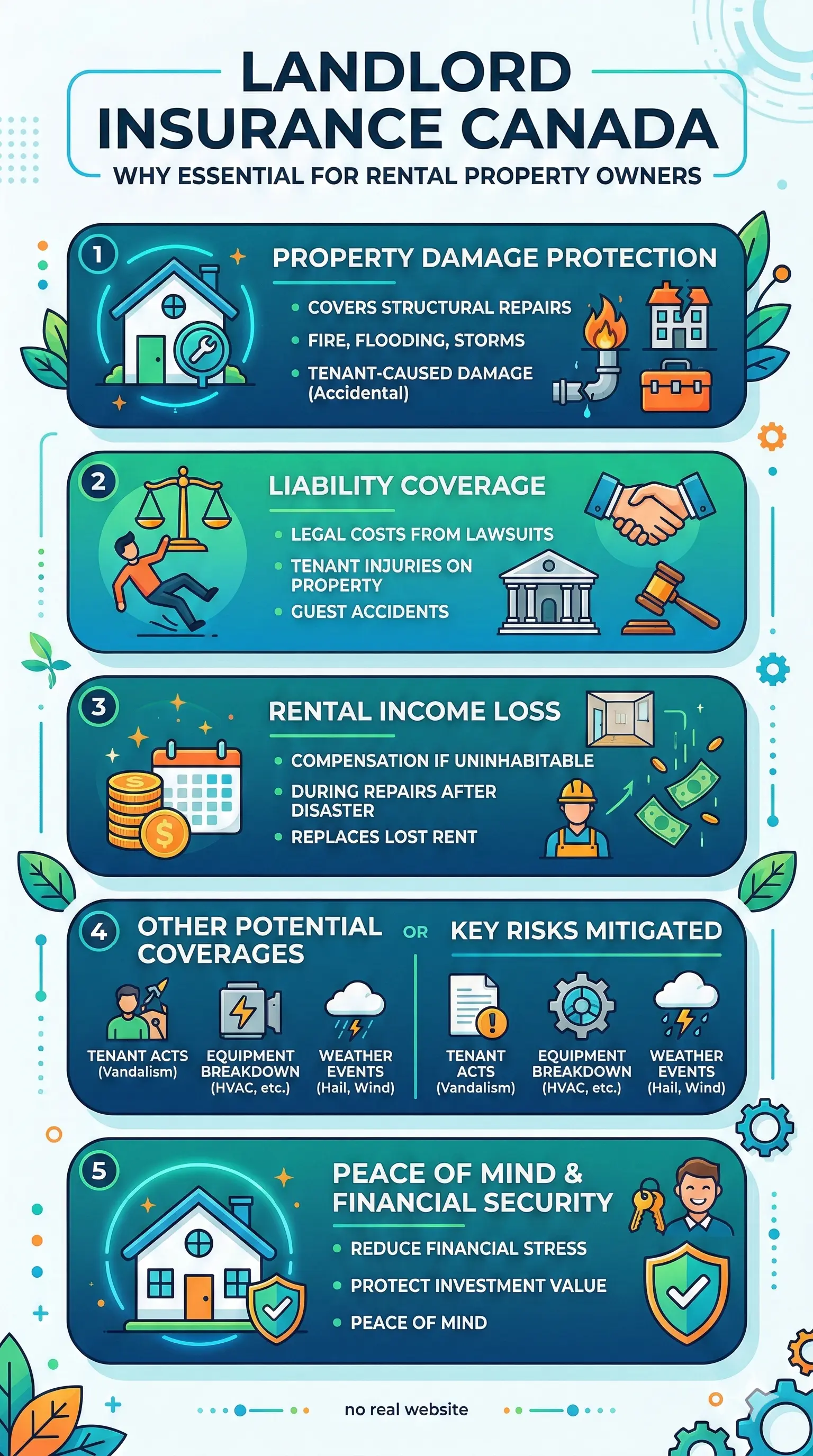
What Does Landlord Insurance in Canada Typically Cover?
Policies vary by province and insurer, but core coverages address the biggest risks for rental property owners. Customise based on your location, like flood-prone areas in BC or harsh winters in Alberta.
Property Damage Coverage
This protects the building structure, detached garages, sheds, and landlord-furnished appliances from perils like fire, wind, hail, theft, and vandalism. Accidental tenant damage is often included, but intentional acts may need extra vandalism protection. Note: floods and earthquakes typically require separate policies.
Liability Insurance
Essential for defending against lawsuits if someone is injured on your property—say, a tenant slips on a broken stair. Coverage handles legal fees, medical bills, and settlements, often with limits of $1-2 million. Provincial laws, like Ontario's Residential Tenancies Act, hold landlords responsible for maintaining safe conditions, making this coverage critical.
Loss of Rental Income (Fair Rental Value)
If damage makes the unit unlivable, this pays the fair market rent during repairs, ensuring you don't lose months of income. Vital for landlords relying on steady cash flow to cover mortgages or CPP contributions.
Additional Coverages to Consider
- Legal expenses for tenant disputes via provincial tribunals like the Landlord and Tenant Board (LTB) in Ontario.
- By-law coverage for upgrades required to meet current building codes post-damage.
- Equipment breakdown for furnaces or water heaters, common failure points in older rentals.
Average premiums start under $100 monthly, with bundles for multiple properties saving more.
Legal Requirements and Provincial Variations in Canada
No federal law mandates landlord insurance Canada, but practical realities do. Mortgage providers demand it, and some municipal licensing—like in certain BC cities—may require liability proof.
Provincial Insights
- Ontario: Landlords can require tenant insurance in leases, enforceable via LTB if breached.
- British Columbia: Tenants aren't legally required to have renters insurance, but landlords should mandate it; focus on Strata rules for apartments.
- Alberta: Security deposits capped at one month's rent, held in trust—insurance complements this by covering beyond deposits.
- Quebec, Atlantic Provinces: Similar flexibility; always check provincial Residential Tenancies Acts for maintenance duties tying into liability.
Landlords must keep units habitable per provincial standards, like Saskatchewan's Act—insurance backs this up financially.
Should You Require Tenant Insurance? Best Practices
It's not mandatory for tenants anywhere in Canada, but include it in leases to reduce your risks. Tenant policies cover their belongings, temporary relocation, and liability—gaps your landlord insurance ignores. Costs them just $12-20 monthly.
Pro Tip: Request proof annually via certificate of insurance. Non-compliance? Issue written notice, then pursue LTB eviction if needed.
How to Choose and Buy Landlord Insurance in 2026
Shop around for 2026 rates influenced by inflation and claims trends. Compare via brokers or sites rating providers highly in ON, BC, QC, AB (4.3-4.6/5).
- Assess Risks: Multi-unit? High-crime area? Add endorsements.
- Get Quotes: Factor property type, location, coverage limits.
- Bundle if Possible: Discounts for multiple rentals or auto/home policies.
- Review Exclusions: Confirm tenant damage, natural perils align with needs.
- Buy from Reputable Insurers: Look for strong claims handling.
Maintenance records strengthen claims—log inspections to prove due diligence.
Common Mistakes to Avoid
- Using homeowner insurance—voids claims.
- Underinsuring liability—aim for $2M+.
- Ignoring tenant requirements—leads to disputes.
- Forgetting updates post-renos or 2026 rate changes.
Protect Your Investment Today
Don't leave your rental empire vulnerable—landlord insurance Canada is the smart must-have for every property owner. Review your policy now, require tenant coverage in leases, and stay compliant with provincial rules like those from the LTB or provincial tenancy boards. Contact a broker for a 2026 quote tailored to your portfolio, and sleep easier knowing your income is secure.
Frequently Asked Questions
Sources & References
-
1
Can a Landlord Require Tenant Insurance - Marathon Insurance — www.marathoninsurance.ca
- 2
-
3
Landlord Insurance in Canada - WOWA.ca — wowa.ca
-
4
Landlord Insurance | Coverage and Legal Requirements - Platuni — www.platuni.com
-
5
Renters' Rights: What Landlords in Canada Need to Know - Zensurance — www.zensurance.com
-
6
Does Landlord Insurance Cover Tenants' Damage? - Western Financial Group — westernfinancialgroup.ca
-
7
What Insurance Do Apartment Owners in British Columbia Need? - Western Coast Insurance — westerncoastinsurance.ca
-
8
Best Landlord Insurance In Canada 2026 - moneyGenius — moneygenius.ca