How to Buy Stocks in Canada 2026: Self-Directed Investing for Beginners
Ever dreamed of building wealth through the stock market but felt overwhelmed by where to start? In 2026, self-directed investing in Canada has never been more accessible, with zero-commission trades...
The Lifetimes Canada editorial team curates, fact-checks, and updates guides on personal finance, property, health, immigration, legal, business, and lifestyle topics relevant to Lifetimes Canada readers. Articles are produced with AI assistance and reviewed by the editorial team before publication.
Ever dreamed of building wealth through the stock market but felt overwhelmed by where to start? In 2026, self-directed investing in Canada has never been more accessible, with zero-commission trades and user-friendly apps putting the power in your hands. Whether you're saving for retirement, a home down payment, or financial independence, this guide walks you through how to buy stocks in Canada as a beginner, step by step.
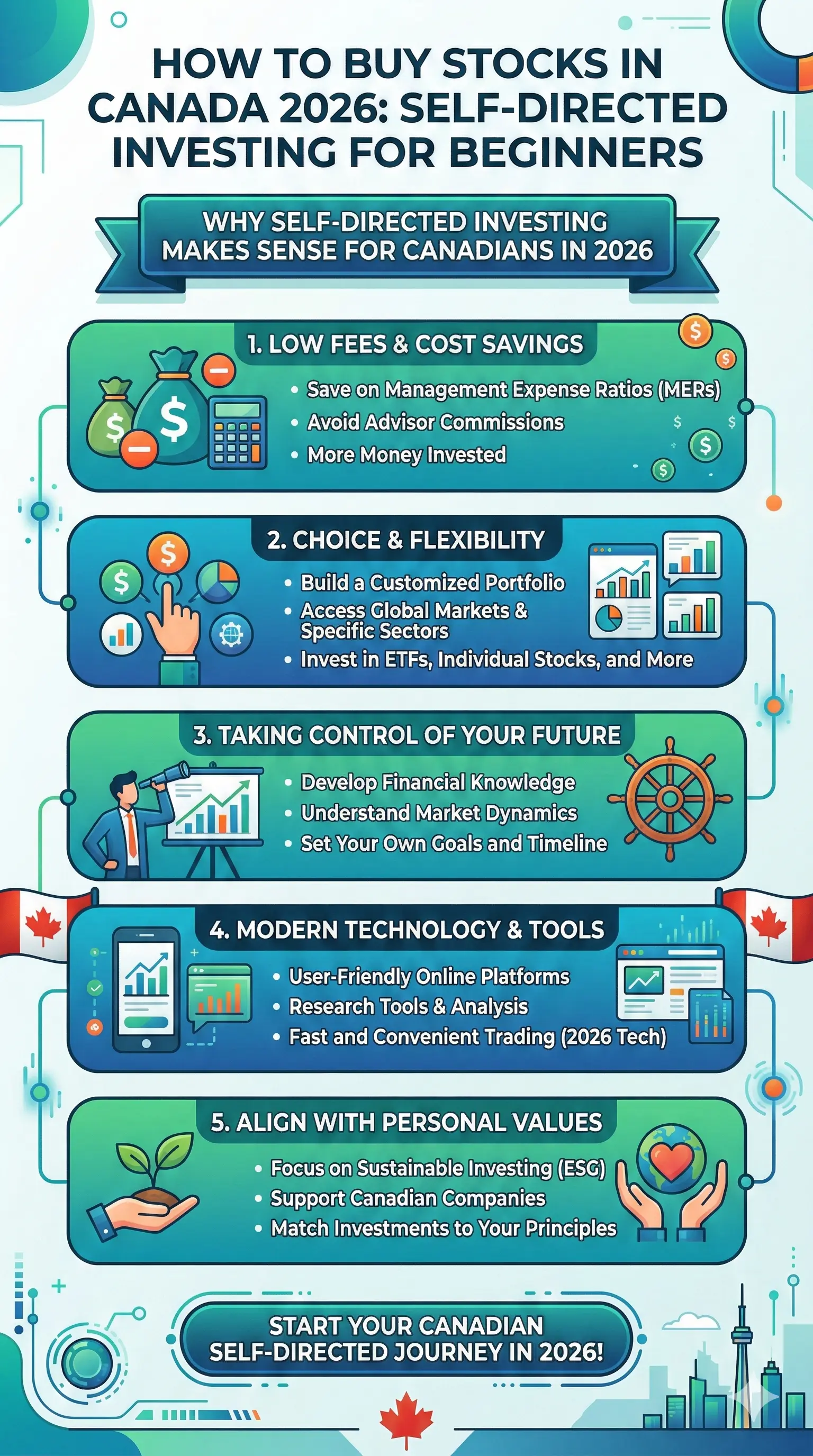
Why Self-Directed Investing Makes Sense for Canadians in 2026
Self-directed investing lets you control your portfolio without relying on a financial advisor, saving on fees while learning the ropes. With platforms like Wealthsimple Trade and Questrade offering commission-free trades, it's easier than ever to start small—even with $10. In Canada, tax-advantaged accounts like TFSAs and RRSPs supercharge your returns by shielding gains from taxes, making 2026 an ideal time to dive in amid rising interest in ETFs and diversified portfolios.
Popular Canadian brokerages in 2026 include Questrade (best overall), TD Direct Investing (top research tools), and Qtrade (great for long-term investors), each with low or no commissions and robust mobile apps. You'll gain exposure to TSX-listed stocks, U.S. markets via NYSE, and global ETFs, all from your phone.
Step-by-Step Guide: How to Buy Your First Stock in Canada
Follow these practical steps to get started today. The entire process can take minutes once you're set up.
Step 1: Assess Your Finances and Set Goals
Before buying, calculate how much you can invest comfortably. Most brokerages have no minimum, but aim for at least $1,000 to diversify and cover fees effectively. Consider your goals: retirement (RRSP), tax-free growth (TFSA), or home buying (FHSA). Evaluate risk tolerance—stocks can fluctuate, so only invest what you won't need short-term.
- Emergency fund first: Build 3-6 months' expenses in a high-interest savings account.
- Pay high-interest debt: Tackle credit cards before stocks.
- Max tax perks: 2026 TFSA limit is $7,000; contribute to grow tax-free.
Step 2: Choose the Right Account Type
Opt for registered accounts to maximize benefits. Here's a quick comparison:
| Account Type | Best For | 2026 Tax Perk |
|---|---|---|
| TFSA | Flexible goals, any age | Tax-free growth & withdrawals |
| RRSP | Retirement | Tax deduction on contributions |
| FHSA | First home | Tax-free withdrawals for home purchase |
| Non-registered | After maxing registered | No tax shelter |
Select based on your needs—many brokerages let you open multiple.
Step 3: Pick a Discount Brokerage
Compare platforms for fees, tools, and investments. Favourites for beginners:
- Wealthsimple Trade: Zero commissions, simple app, great for ETFs.
- Questrade: Low fees, advanced charts, ETF purchases free.
- Interactive Brokers (IBKR): Access TSX and NYSE, low costs for active traders.
- TD Direct Investing or Qtrade: Strong research, bank integration.
Look for wide investment options (stocks, ETFs, mutual funds), mobile apps, and education resources. Newcomers need SIN, ID, and proof of address.
Step 4: Open and Fund Your Account
Sign up online—provide personal details, answer investor profile questions, and verify ID. Approval is quick, often instant. Link your bank and deposit via EFT (free, 1-2 days) or wire. Start with what you can afford; many have no minimums.
Step 5: Research and Select Stocks or ETFs
Don't chase hot tips—focus on quality. Search by ticker (e.g., RY for Royal Bank on TSX).
- For beginners: ETFs like XIU (TSX 60) or VFV (S&P 500) for instant diversification.
- Canadian staples: Banks (TD, RBC), energy (ENB), tech (Shopify).
- U.S. exposure: Allocate 20-30% to U.S. stocks for growth.
Review fundamentals: earnings, dividends, sectors. Diversify across resources, financials, tech, utilities, consumer goods.
Step 6: Place Your First Trade
Enter ticker, shares, and order type:
- Market order: Buys at current price (fast).
- Limit order: Sets your max price (control).
Confirm—ensure funds cover cost plus fees. Done! Monitor via app.
Essential Tips for Self-Directed Success in 2026
Diversify Like a Pro
Think like a portfolio manager: mix leaders (e.g., RBC) and laggards for upside. Spread across sectors; hold U.S. stocks for balance. ETFs make this easy—one fund covers dozens of companies.
Watch Fees and Taxes
Zero-commission trades are standard, but check ECN fees or currency conversion for U.S. buys. Use Norbert's Gambit for FX savings. Track capital gains in non-registered accounts via CRA-adjusted cost base.
Avoid Common Pitfalls
- Don't time the market—invest regularly (dollar-cost averaging).
- Ignore hype; stick to profitable, dividend-paying firms.
- Be patient: Hold long-term for compounding.
FAQ: How to Buy Stocks in Canada 2026
1. Do I need a lot of money to start?
No—many platforms allow $10 trades, but $1,000+ enables diversification.
2. TFSA or RRSP first?
TFSA for flexibility; RRSP if in high tax bracket for deductions.
3. Are there taxes on stock sales?
Yes in non-registered (50% of gains taxable); none in TFSA/RRSP.
4. Can newcomers invest?
Yes—with SIN, passport, address proof. Try TD Easy Trade.
5. Best beginner investments?
ETFs tracking TSX or S&P 500 for low-risk entry.
6. How much are trading fees in 2026?
Often $0 at Wealthsimple/Questrade; $5-10 elsewhere.
Your Next Steps to Stock Market Success
Ready to act? Open a TFSA at Wealthsimple Trade or Questrade today, fund $500, and buy an ETF like XIU. Track progress monthly, rebalance yearly, and scale up. With discipline, your self-directed journey can build lasting wealth—start small, stay consistent, and watch compounding work its magic. Consult CRA for personalized tax advice, and happy investing!