Cost of ClearCorrect vs Invisalign in Canada 2026
If you’re considering straightening your teeth without the metal brackets and wires of traditional braces, you’ve likely come across two major names: Invisalign and ClearCorrect. Both are popular clea...
The Lifetimes Canada editorial team curates, fact-checks, and updates guides on personal finance, property, health, immigration, legal, business, and lifestyle topics relevant to Lifetimes Canada readers. Articles are produced with AI assistance and reviewed by the editorial team before publication.
ClearCorrect vs Invisalign in Canada 2026: A Cost Breakdown
If you’re considering straightening your teeth without the metal brackets and wires of traditional braces, you’ve likely come across two major names: Invisalign and ClearCorrect. Both are popular clear aligner systems that offer a discreet way to achieve a straighter smile. But when it comes to choosing between them in Canada, the cost difference is often the deciding factor.
In 2026, the price gap between ClearCorrect and Invisalign has narrowed, but important distinctions remain in terms of treatment scope, provider support, and what you actually get for your money. We’ve researched the latest pricing, clinical considerations, and insurance coverage to help you make an informed decision that suits both your smile and your budget.
What Are ClearCorrect and Invisalign?
Both ClearCorrect and Invisalign are brands of clear aligner therapy. They work by using a series of custom-made, removable plastic trays that gradually shift your teeth into their desired position. Unlike generic mail-order aligners, both systems require in-person supervision by a licensed dentist or orthodontist, which is a key safety advantage.
Invisalign, launched in 1997, is the more established brand and is often seen as the gold standard. ClearCorrect, founded in 2006, has grown significantly and is known for offering a more flexible treatment approach, particularly for complex cases. Both are widely available across Canada, from Vancouver to Halifax.
Cost of ClearCorrect vs Invisalign in Canada 2026
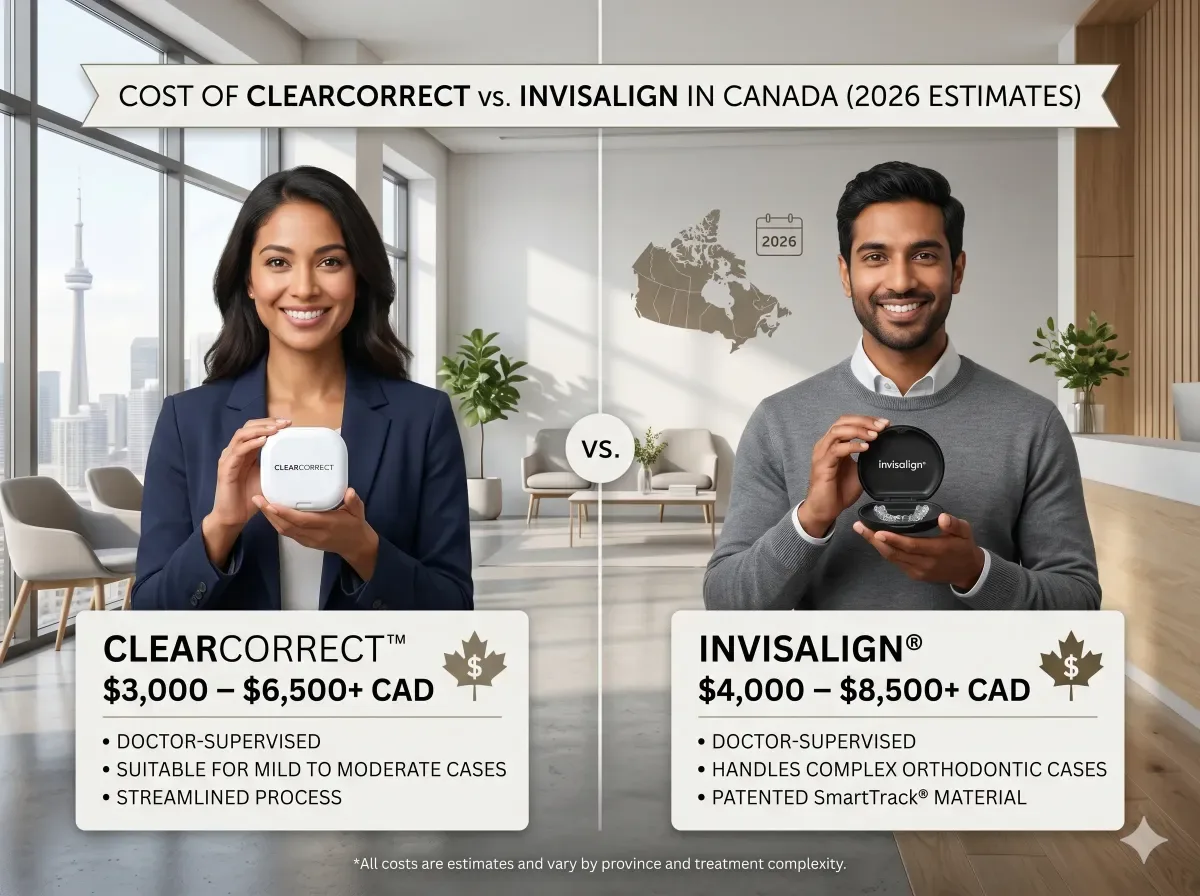
The cost of clear aligner treatment in Canada depends on several factors: the complexity of your case, the experience of your provider, your geographic location, and the specific brand used. In 2026, here’s a general price range for each system:
- Invisalign (Full Comprehensive Treatment): $4,500 – $8,500 CAD
- Invisalign (Lite or Express): $2,500 – $4,000 CAD
- ClearCorrect (Full Comprehensive Treatment): $3,500 – $6,500 CAD
- ClearCorrect (Limited or Express): $2,000 – $3,500 CAD
On average, ClearCorrect tends to be 15% to 25% less expensive than Invisalign for comparable treatment plans. However, the final price you pay will depend heavily on your specific needs and the clinic you choose.
What’s Included in the Price?
When comparing costs, it’s important to understand what’s included. Both systems typically cover:
- Initial consultation and digital scanning (often using iTero or similar 3D scanners)
- Custom aligner fabrication
- All aligner sets for the full treatment plan (including refinements)
- Retainers after treatment (usually one set, sometimes two)
- Regular check-up appointments with your provider
However, some clinics may charge extra for retainers beyond the first set, for additional refinement aligners beyond a certain number, or for emergency visits. Always ask for a detailed breakdown before committing.
Key Differences Between ClearCorrect and Invisalign
Treatment Approach and Technology
Invisalign uses proprietary SmartTrack material, which is designed to apply gentle, consistent force. It also offers features like SmartForce attachments and precision cuts for elastics, making it highly effective for a wide range of cases, from mild crowding to complex bite issues.
ClearCorrect uses a different material and a unique approach called "ClearSync" that allows for more flexible treatment planning. One notable difference is that ClearCorrect aligners are manufactured in a single-piece design (no seams), which some patients find more comfortable. ClearCorrect also offers unlimited refinements at no extra cost for comprehensive plans, while Invisalign typically includes a set number of refinement aligners (usually up to 3 sets).
Treatment Duration
Treatment times are similar for both systems, typically ranging from 6 to 18 months for full treatment. Invisalign’s Lite and Express options can be as short as 3 to 6 months. ClearCorrect’s limited plans are similarly quick. However, complex cases requiring significant tooth movement or bite correction may take longer with either system.
Provider Network and Support
Invisalign has a larger network of trained providers in Canada, with over 1,000 orthodontists and dentists offering the system. This means you may have more choice when selecting a provider. ClearCorrect’s network is smaller but growing, and many providers offer both systems, allowing you to compare options at the same clinic.
Insurance Coverage in Canada
Most Canadian dental insurance plans consider clear aligner treatment a cosmetic procedure, meaning coverage is often limited or excluded. However, some plans do offer partial coverage under orthodontic benefits, especially if the treatment addresses functional issues like bite problems or jaw pain.
In 2026, typical coverage ranges from $1,000 to $3,000 CAD for orthodontic treatment, with a lifetime maximum. Some plans may cover a percentage (e.g., 50%) up to a cap. Both Invisalign and ClearCorrect are treated similarly by insurers, so the brand choice usually doesn’t affect coverage amounts.
Health Spending Accounts (HSAs) and Flexible Spending Accounts (FSAs) can also be used to pay for aligner treatment with pre-tax dollars. Check with your employer or benefits provider to see if you have this option.
Which System Is Right for You?
Choosing between ClearCorrect and Invisalign isn’t just about price. Here’s a quick guide:
- Choose Invisalign if: You have a complex case (severe crowding, deep bite, crossbite), you want the largest provider network, or you prefer the most established brand with extensive clinical research.
- Choose ClearCorrect if: You’re looking for a more affordable option, you want unlimited refinements for comprehensive treatment, or you prefer a seamless aligner design.
Ultimately, the best choice is the one that your dentist or orthodontist recommends based on your specific dental anatomy. A proper consultation with digital scanning and treatment planning is essential.
How to Save Money on Clear Aligners in Canada
Clear aligner treatment is an investment, but there are ways to make it more affordable:
- Shop around: Get quotes from at least two or three providers. Prices can vary significantly even within the same city.
- Ask about payment plans: Many clinics offer interest-free financing or monthly payment plans spread over 12 to 24 months.
- Use your HSA or FSA: If you have a Health Spending Account, you can use pre-tax dollars to pay for treatment.
- Check for promotions: Some clinics offer discounts for paying in full upfront or for booking during certain months.
- Consider a dental school: Some Canadian universities with dental programs offer reduced-cost treatment under supervision (e.g., University of Toronto, University of British Columbia).
Next Steps for Canadians Considering Clear Aligners
If you’re ready to explore clear aligner treatment, here’s a simple action plan:
- Book a consultation with a dentist or orthodontist who offers both ClearCorrect and Invisalign. This allows you to compare options directly.
- Ask for a detailed quote that includes all fees: consultation, scanning, aligners, refinements, retainers, and any follow-up visits.
- Check your insurance coverage and explore payment options like HSAs or financing plans.
- Consider your priorities: Are you most concerned about cost, treatment speed, or brand reputation? Your provider can help match you with the right system.
Straightening your teeth is a personal journey, and the right choice depends on your unique needs. Both ClearCorrect and Invisalign offer excellent results when used under professional supervision. By understanding the costs and differences, you’re already one step closer to the smile you deserve.
Frequently Asked Questions
Sources & References
-
1
Government of Canada — Dental Care — www.canada.ca
-
2
Canada Revenue Agency — Health Spending Accounts — www.cra-arc.gc.ca
-
3
Statistics Canada — Dental Care Statistics — www.statcan.gc.ca
-
4
Invisalign Canada Official Site — www.invisalign.ca
-
5
ClearCorrect Official Site — www.clearorrect.com
-
6
Canadian Dental Association — Orthodontic Treatment — www.cda-adc.ca
Related Articles

Invisalign vs Traditional Braces Cost in Canada 2026
Few decisions in life are as visible as the one you make about your smile. If you’re considering straightening your teeth in 2026, you’ve likely hit the central question: Invisalign vs traditional bra...
Cost of Dentures in Canada 2026: Snap-In vs Traditional
If you’re researching tooth replacement options in Canada, you’ve likely noticed one thing first: the price tags vary wildly. Whether you’re looking at a simple partial denture or a full set of snap-i...
Root Canal and Crown Cost in Canada 2026
Facing a root canal and crown procedure can feel daunting, especially when you start thinking about the cost. If you're a Canadian, you know that dental care isn't covered by our public health system,...
Emergency Dentist in Canada: What to Do for a Knocked-Out Tooth
Imagine you're at a hockey game or playing with your kids when suddenly—a puck, a fall, or an unexpected collision knocks out one of your teeth. Panic sets in, but acting fast can make all the differe...