Invisalign vs Traditional Braces Cost in Canada 2026

Few decisions in life are as visible as the one you make about your smile. If you’re considering straightening your teeth in 2026, you’ve likely hit the central question: Invisalign vs traditional bra...
The Lifetimes Canada editorial team curates, fact-checks, and updates guides on personal finance, property, health, immigration, legal, business, and lifestyle topics relevant to Lifetimes Canada readers. Articles are produced with AI assistance and reviewed by the editorial team before publication.
Few decisions in life are as visible as the one you make about your smile. If you’re considering straightening your teeth in 2026, you’ve likely hit the central question: Invisalign vs traditional braces cost in Canada. It’s not just about price, though—it’s about value, lifestyle, and how long you’re willing to wait for results. Let’s break down the real numbers and what they mean for your wallet and your smile.
In 2026, the average cost for a full course of orthodontic treatment in Canada ranges from roughly $3,500 to $9,000. The exact figure depends on the complexity of your case, your location, and the type of appliance you choose. As a general rule, traditional metal braces are the more affordable option upfront, while Invisalign tends to carry a premium. But the gap is narrowing, and financing options make both accessible.
What Drives the Cost in Canada?
Before comparing apples to apples, it helps to understand what you’re paying for. Orthodontic fees in Canada are not regulated by a single federal body, but most provinces have guidelines or fee guides published by local dental associations (e.g., the Ontario Dental Association or British Columbia Dental Association). These guides provide a range, but individual orthodontists set their own prices based on:
- Complexity of the case — mild crowding costs less than a severe overbite.
- Treatment duration — longer treatments mean more appointments and adjustments.
- Geographic location — expect higher fees in Toronto, Vancouver, and Calgary compared to smaller cities.
- Orthodontist vs dentist — orthodontists are specialists with two to three years of additional training, and their fees often reflect that expertise.
Traditional Braces: Cost and Considerations
Traditional metal braces remain the workhorse of orthodontics. They are effective for virtually all types of malocclusion, from simple crowding to complex skeletal issues.
Average Cost in Canada (2026)
For a full treatment (typically 18 to 36 months), you can expect to pay between $3,500 and $7,500 [1]. This includes the initial consultation, placement, periodic adjustments (usually every 4–8 weeks), and the removal and retention phase. Some orthodontists quote a flat fee that covers everything, while others charge per visit.
Pros and Cons
- Pros: Highly effective for complex cases; no risk of losing aligners; often faster for severe issues; less expensive upfront.
- Cons: Visible appearance; food restrictions (no popcorn, gum, sticky candy); more difficult oral hygiene; occasional discomfort from wires and brackets.
If you have a complex bite issue or are a heavy grinder, your orthodontist may strongly recommend traditional braces over clear aligners. They are also a good choice for children and teenagers who may not be diligent about wearing aligners 22 hours a day.
Invisalign: Cost and Considerations
Invisalign uses a series of clear, removable aligners that are custom-made for your teeth. It’s popular with adults and teens who want a less noticeable option.
Average Cost in Canada (2026)
Invisalign treatment typically ranges from $4,000 to $9,000 [2]. The price varies significantly based on the tier of treatment:
- Invisalign Express (minor corrections, 10–20 aligners): $2,500–$4,000
- Invisalign Lite (moderate crowding, up to 14 aligners): $3,500–$5,500
- Invisalign Comprehensive (full treatment, unlimited aligners for up to 5 years): $5,000–$9,000
Pros and Cons
- Pros: Nearly invisible; removable for eating and cleaning; no food restrictions; fewer orthodontic visits; digital treatment planning.
- Cons: Requires discipline to wear 20–22 hours/day; not suitable for severe cases; can be lost or damaged; may take longer for complex movements.
Invisalign is an excellent choice for adults with mild to moderate crowding or spacing. It’s also a great option if you’re a professional who wants to maintain a polished appearance during treatment.
Cost Comparison: Invisalign vs Traditional Braces
To help you visualize the difference, here’s a side-by-side look at typical costs in 2026 across Canada.
| Treatment Type | Cost Range (CAD) | Typical Duration | Best For |
|---|---|---|---|
| Traditional Metal Braces | $3,500 – $7,500 | 18–36 months | Complex cases, children, teens |
| Invisalign Express | $2,500 – $4,000 | 3–6 months | Minor crowding or spacing |
| Invisalign Lite | $3,500 – $5,500 | 6–12 months | Moderate crowding |
| Invisalign Comprehensive | $5,000 – $9,000 | 12–24 months | Full treatment, adults |
Note: Prices are estimates based on 2026 data from Canadian orthodontic practices and fee guides. Actual costs may vary.
Insurance and Tax Considerations in Canada
Orthodontic treatment is considered a medical expense in Canada. If you have private insurance through your employer, check your plan details. Many group plans cover a portion of orthodontic fees, typically 50% up to a lifetime maximum (commonly $2,500–$3,000). Some plans have age limits (e.g., coverage only for dependents under 18).
You can also claim orthodontic fees on your income tax return as a medical expense. The Canada Revenue Agency (CRA) allows you to deduct eligible medical expenses that exceed 3% of your net income or $2,635 (2025 threshold, adjusted annually) [3]. Keep all receipts and a letter from your orthodontist detailing the treatment plan.
If you’re paying out of pocket, many orthodontists offer interest-free payment plans. Some clinics also partner with third-party financing companies like Medent or PayBright. Always ask before committing.
Which One Should You Choose?
The answer depends on your priorities. Here’s a quick guide:
- Choose traditional braces if: You have a complex bite issue, you’re on a tighter budget, you’re a teenager, or you don’t trust yourself to wear aligners consistently.
- Choose Invisalign if: You’re an adult with mild to moderate crowding, you want a discreet option, or you prefer fewer food restrictions and easier cleaning.
It’s also worth noting that some orthodontists offer a combination approach—using traditional braces for the heavy lifting and finishing with Invisalign for fine-tuning. This hybrid option can be cost-effective and yield excellent results.
Your Next Steps
Choosing between Invisalign and traditional braces is a personal decision that balances cost, convenience, and clinical need. Start by booking a consultation with a licensed orthodontist. Most offer free or low-cost initial assessments. During that visit, ask for a detailed quote, a treatment timeline, and information about payment plans.
Remember: the cheapest option isn’t always the best value. A well-executed treatment plan from a qualified professional will save you time, money, and frustration in the long run. Your smile is an investment—make it count.
Frequently Asked Questions
Sources & References
-
1
Canadian Dental Association — Orthodontic Treatment — www.cda-adc.ca
-
2
Invisalign Canada — Official Site — www.invisalign.ca
-
3
Canada Revenue Agency — Eligible Medical Expenses — www.canada.ca
-
4
Statistics Canada — Consumer Price Index for Dental Services — www.statcan.gc.ca
-
5
Ontario Dental Association — Fee Guide — www.ontariodentalassociation.ca
Related Articles
Cost of Dentures in Canada 2026: Snap-In vs Traditional
If you’re researching tooth replacement options in Canada, you’ve likely noticed one thing first: the price tags vary wildly. Whether you’re looking at a simple partial denture or a full set of snap-i...
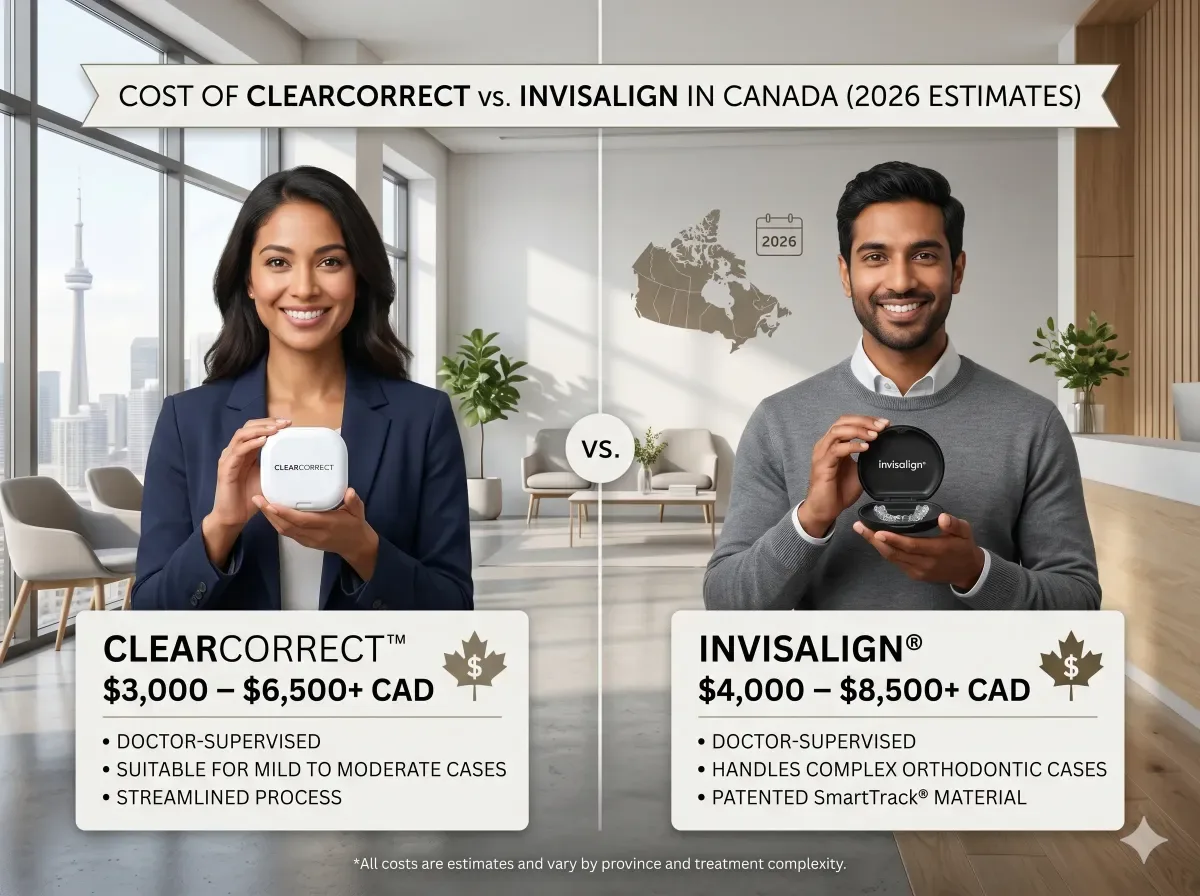
Cost of ClearCorrect vs Invisalign in Canada 2026
If you’re considering straightening your teeth without the metal brackets and wires of traditional braces, you’ve likely come across two major names: Invisalign and ClearCorrect. Both are popular clea...
Root Canal and Crown Cost in Canada 2026
Facing a root canal and crown procedure can feel daunting, especially when you start thinking about the cost. If you're a Canadian, you know that dental care isn't covered by our public health system,...
Emergency Dentist in Canada: What to Do for a Knocked-Out Tooth
Imagine you're at a hockey game or playing with your kids when suddenly—a puck, a fall, or an unexpected collision knocks out one of your teeth. Panic sets in, but acting fast can make all the differe...