Canada Housing Market Forecast 2026: Will Prices Drop or Rise?

As Canadians, we've all felt the rollercoaster of the housing market over the past few years—sky-high prices during the pandemic boom, followed by a sharp correction in 2025. Now, heading into 2026, y...
The Lifetimes Canada editorial team curates, fact-checks, and updates guides on personal finance, property, health, immigration, legal, business, and lifestyle topics relevant to Lifetimes Canada readers. Articles are produced with AI assistance and reviewed by the editorial team before publication.
As Canadians, we've all felt the rollercoaster of the housing market over the past few years—sky-high prices during the pandemic boom, followed by a sharp correction in 2025. Now, heading into 2026, you're likely wondering: will prices finally drop enough to make homeownership achievable, or are we staring down another round of increases? This forecast breaks it down with the latest data, regional insights, and practical advice to help you decide whether to buy, sell, or hold.
National Overview: Stabilisation and Mild Recovery Expected
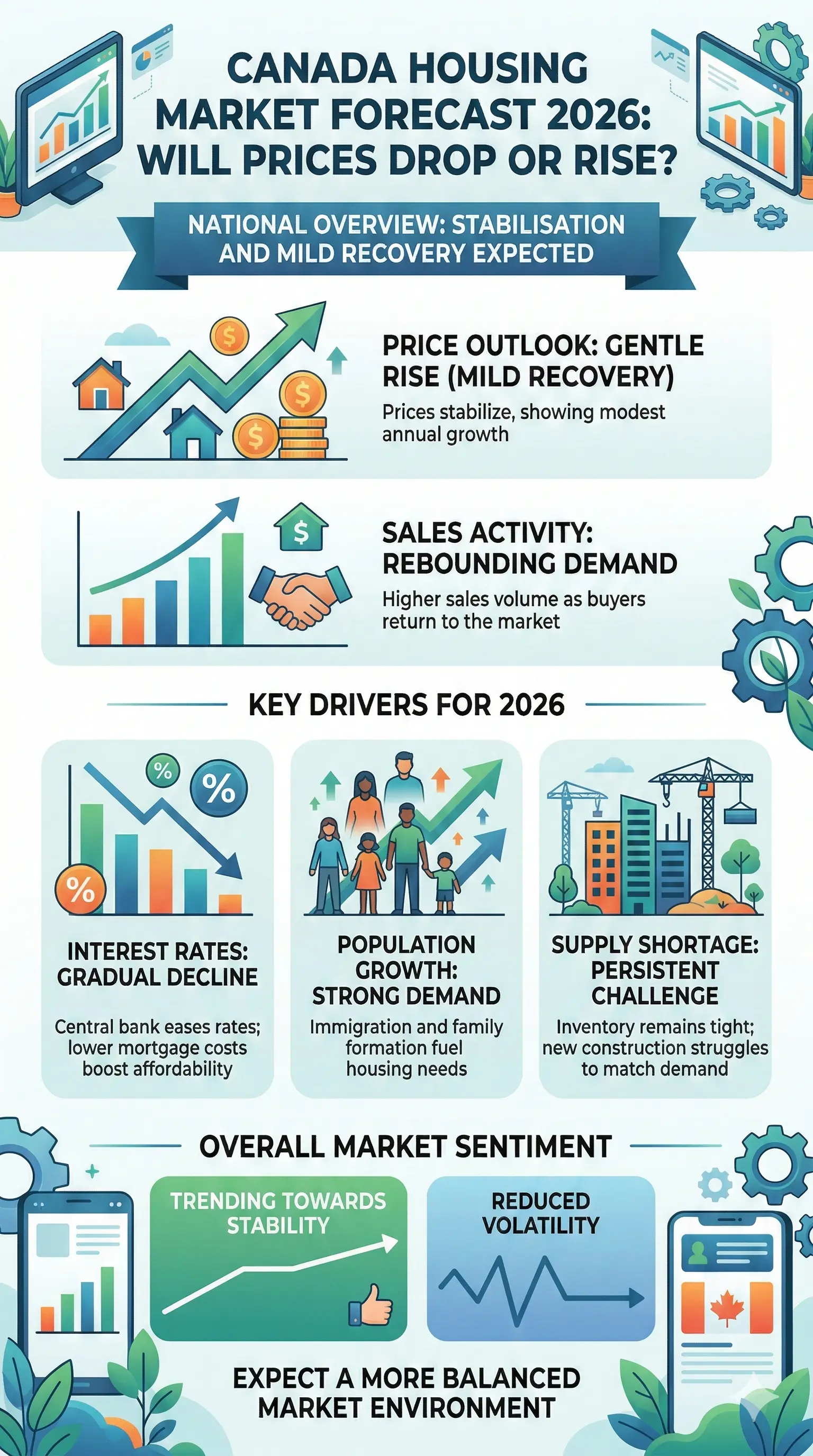
Canada's housing market is poised for a year of bottoming out in 2026, characterised by stabilisation, moderate sales growth, and largely flat prices nationwide. After a soft finish to 2025, forecasters anticipate a gradual, modest recovery driven by pent-up demand from first-time buyers, though restrained by economic uncertainty, subdued job growth, and steady interest rates from the Bank of Canada.
January 2026 data reflects this cautious start: national average home prices dipped to $652,941, down 2.6% from the previous year, with the benchmark price at $658,300, marking an 4.9% year-over-year decline. Sales cooled amid winter weather in central Canada, but new listings surged 7.3% month-over-month, pushing the sales-to-new-listings ratio to 45%—a balanced level suggesting no immediate price pressure.
Key drivers include maturing demand from recent immigrants who've gained the two-year residency needed for better mortgage access, acting as a price floor in major cities like Toronto, Vancouver, Montreal, and Calgary. However, high construction costs—exacerbated by trade tensions—and low buyer confidence are expected to keep national prices flat to slightly down.
Supply and Demand Dynamics
Housing starts hit a strong 260,000 units in 2025—the third-highest on record—but momentum has softened, forecasting subdued activity in 2026. This pullback widens the supply gap against Canada's growing needs, potentially reigniting affordability pressures later in the year if demand rebounds without matching builds.
- Pent-up demand: First-time buyers, sidelined by high rates, may re-enter as affordability improves slightly.
- Immigration boost: New residents transitioning from rentals will prop up urban demand.
- Supply constraints: Developers favour rentals over condos due to stalled pre-sales, limiting ownership inventory.
With the Bank of Canada likely holding rates steady, fixed mortgage rates should remain neutral, neither boosting nor hindering activity significantly.
Regional Breakdown: Prices to Diverge Across Provinces
While the national picture is stable, regional splits are sharpening in 2026—Canada's most pronounced in years. Here's what to expect province by province.
Ontario: Potential Price Declines Amid Soft Economy
Ontario, especially the Greater Golden Horseshoe and Southwestern regions, faces downward pressure. Sales dropped sharply in January due to weather, but even adjusted, expect easing activity as job growth slows and per capita sales exceed long-term averages. Prices may decline modestly, particularly for condos, as resale supply rises from prior gains.
Tip for Ontario buyers: Monitor the sales-to-new-listings ratio closely—if it stays below 45%, negotiate aggressively on price.
British Columbia: Flat to Modest Gains with Labour Recovery
B.C.'s market could see slight price upticks, driven by a recovering labour market and condo sales mix, though demographic shifts and trade volatility temper growth. Vancouver and Victoria saw listing surges in January, balancing conditions.
Prairies (Alberta): Trend-Like Growth
Alberta anticipates balanced supply-demand, cooling population gains, and flat oil prices leading to moderate price rises aligned with long-term trends. Calgary led new listings in January, signalling seller optimism.
Quebec: Firm Early, Then Cooling
Quebec starts 2026 with tight conditions supporting price growth, but rising resale supply and slowing sales will pull it below averages later. Montreal and Quebec City boosted national listings.
| Province | 2026 Price Outlook | Key Factor |
|---|---|---|
| Ontario | Slight decline | Soft jobs, high supply |
| B.C. | Flat to modest rise | Labour recovery |
| Alberta | Trend growth | Balanced conditions |
| Quebec | Firm then cooling | Increasing listings |
Factors Influencing the 2026 Forecast
Interest Rates and Bank of Canada Policy
Expect the Bank of Canada to stay sidelined, with rates levelling off. This neutral stance supports modest recovery but curbs aggressive rebounds. For mortgages, check CRA's latest rules on RRSP Home Buyers' Plan withdrawals or FHSA contributions to maximise down payments.
Economic Headwinds: Jobs, Trade, and Population
Subdued job markets and trade uncertainties (e.g., U.S. tariffs) loom large, potentially slowing demand. Slowing population growth eases pressure but doesn't erase the supply crunch.
Government Interventions
Watch for federal tweaks like housing tax changes or EI extensions for buyers. Provinces may adjust property transfer taxes—Ontario's recent rebates for first-timers remain key.
Practical Tips for Canadian Buyers, Sellers, and Renters
Whether you're in Toronto or Calgary, here's actionable advice:
- Get pre-approved: Lock in rates early via a mortgage broker; use the CMHC mortgage calculator at cmhc-schl.gc.ca.
- Build your down payment: Max TFSA/RRSP contributions; first-time buyers can withdraw up to $60,000 tax-free via HBP.
- Sellers: Price realistically—use CREA's local MLS data for comps. In balanced markets (45-65% ratio), expect negotiations.
- Renters: Easing rental markets in some areas offer breathing room; consider lease transfers if eyeing ownership.
- Diversify: Explore Prairie markets for affordability or B.C. rentals turning ownership-ready.
"Notwithstanding the chilly start to the year, we continue to expect 2026 will ultimately be defined by pent-up demand from first-time buyers." — Shaun Cathcart, CREA Senior Economist
Next Steps: Plan Smart for 2026
Track monthly CREA reports and local MLS trends to stay ahead. Consult a REALTOR® familiar with your region, run affordability scenarios using canada.ca tools, and stress-test your budget. Whether prices tick up modestly or hold steady, preparation beats speculation—2026 could be your window into the market. Contact a local expert today to map your move.
Frequently Asked Questions
Sources & References
-
1
A Review of 2025 and Outlook for 2026 — www.reic.ca
-
2
Provincial Housing Market Outlook: Location ... - TD Economics — economics.td.com
- 3
- 4
-
5
Canada's Housing Outlook 2026: What Happens Next for Prices ... — www.youtube.com
-
6
2025 Housing Market Outlook — www.cmhc-schl.gc.ca
- 7